Practical Sustainability Playbook for Large-Scale SA Experiential Activations
A practical guide for South African brands and agencies to deliver sustainable experiential activations. Focused on waste prevention, local procurement, on-site management, and measurable outcomes within SA’s regulatory and logistical context.
A direct, self-contained answer: Start with a waste audit, design for reuse, source locally, and measure outcomes against clear targets. Then align on-site operations, transport planning, and regulatory compliance to keep a large activation sustainable and on budget.
Context: sustainability in South Africa’s experiential landscape
South Africa presents a dynamic mix of climates, venues, and regulations for live experiences. Outdoor activations must contend with weather variability—from heat to sudden showers—making robust contingency planning essential. Local procurement isn’t just a sustainability choice; it’s a practical one. Sourcing materials, decor, and services from nearby suppliers reduces transport emissions, supports local jobs, and can ease lead times tied to import logistics.
Regulatory and permitting requirements vary by municipality and venue. Fire safety, crowd management, traffic control, and environmental considerations are commonly coordinated through the host venue, city council, or event organisers, with specific permits often required for road closures or large-scale installations. Labour and safety standards are shaped by SA norms and collective agreements, so aligning with local partners helps ensure compliance and smoother operations.
Budgeting for sustainability isn’t an add-on; it’s a design choice that can reduce waste, lower disposal costs, and improve audience experience. A well-planned sustainability approach also positions brands as responsible and responsive to SA audiences, where environmental and social impact matters to stakeholders and attendees alike.
Practical guidance: Step-by-step plan
-
1) Conduct a pre-event waste audit and set targets
Audit current waste streams and identify major contributors (packaging, single-use decor, printed materials). Set targets such as a percentage reduction in waste sent to landfill, a target reuse rate for decor, and a minimum recycling split on site. In SA, involve the venue and local waste contractors early to ensure realistic, enforceable goals within production timelines.
-
2) Design with reuse in mind: modular sets and reusable decor
Invest in modular, reusable structural elements and décor that can be repurposed across events. Use standardized connectors, durable materials, and clearly labeled components to simplify repackaging. This reduces the need for new materials and lowers disposal costs after the activation.
-
3) Source locally: procurement and supplier coordination in SA
Build a local supplier map early, prioritising vendors with sustainable practices and trackable supply chains. Engage with local printers, fabricators, and rental houses to minimize transport distances and support B-BBEE or other local procurement objectives. Ask suppliers for waste-minimisation plans and data on material reuse rates.
-
4) Materials management on site: segregation, recycling, and composting
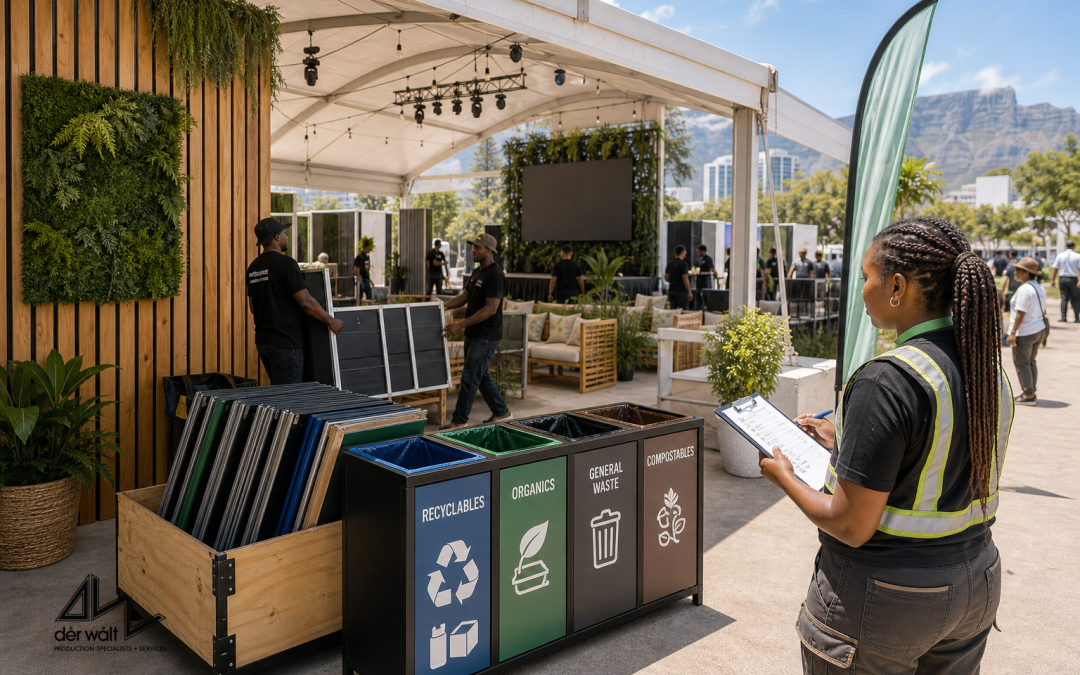
Set up clearly marked waste streams (e.g., recyclables, organics, general waste) with trained stewards. Place accessible nearby compaction and sorting points, and arrange for post-event removal and recycling credits. For SA venues, coordinate with on-site facilities to handle hazardous waste or special materials safely.
-
5) Transport and travel: reducing emissions and costs
Plan consolidated shipments, group deliveries by geography, and optimise routes to minimize carbon footprint and fuel costs. Encourage attendee alternatives such as shuttle services, public transport partnerships, or encouraging ride-sharing where feasible. Every saved kilometre improves budgets and the event’s sustainability profile.
-
6) Compliance, safety, and measurement: integrate reporting from day one
Link sustainability targets to safety plans and permit requirements. Implement simple, auditable data collection: waste diverted, materials reused, and transport kilometres. At the post-event stage, analyse results against targets, and share learnings with stakeholders to improve future activations.
Practical guidance: On-site operations and safety considerations
On-site execution is where sustainability translates into tangible outcomes. Clear signage, trained crew, and simple processes reduce waste and improve audience experience. In SA, consider weather contingency plans (shade, water access, drainage) and security coordination, as well as traffic management and crowd flow, which influence both safety and sustainability outcomes.
Checklist: Quick wins and common pitfalls
- Choose durable, reusable materials over single-use items whenever possible.
- Request detailed waste management plans from all suppliers.
- Prioritise local procurement to shorten supply chains and support communities.
- Integrate a simple, labeled waste-sorting system on site.
- Document baseline metrics and set realistic, trackable targets.
- Involve venue teams early to align permits, safety, and waste processes.
- Avoid over-designing decor that cannot be reused; plan for modularity.
- Plan for energy efficiency: LED lighting, efficient power distribution, and solar where feasible.
FAQ
What is ISO 20121 and should SA events pursue it?
ISO 20121 is an international standard for event sustainability management systems. It provides a framework to plan, implement, and improve sustainability across all event stages. While certification is voluntary, adopting its principles helps structure accountability and continuous improvement for SA activations.
How do I set realistic waste reduction targets for a big activation?
Start with a waste audit of past events or current operations, identify the largest waste streams, and set SMART targets (specific, measurable, achievable, relevant, time-bound). Pair targets with concrete actions (reuse, recycling, and on-site sorting) and assign ownership across teams.
Which local suppliers should I engage for sustainable production in SA?
Prioritise suppliers with verifiable sustainability practices, local production capability, and transparent reporting. Build a supplier roster early, including decor, fabrication, printing, catering disposables, and waste management partners who can support on-site sorting and post-event recycling or composting.
How can I balance sustainability with safety and budget constraints on site?
Integrate safety and sustainability planning from the outset. Choose durable materials that reduce waste and long-term costs, and work with the venue to align permits and crowd-control plans. Use modular designs to amortize costs across multiple activations and avoid over-engineering.
What metrics should I report after the event?
Key metrics include waste diverted from landfill, rate of material reuse, total transport kilometres and emissions, energy consumption, and supplier compliance with sustainability commitments. Present results alongside practical learnings to inform future events.
Sources
- ISO 20121: Event sustainability management system — ISO
- Global Sustainable Tourism Council (GSTC) – Sustainability criteria — GSTC
- A Greener Festival – Resources for greener events — A Greener Festival
Call to action
Ready to elevate your SA activation with end-to-end sustainability, exceptional production, and seamless supplier coordination? DERWALT partners with brands and agencies to deliver experiential marketing, activation planning, and robust event-production support that respects budgets and timelines.
Recent Comments