Practical Safety Risk Assessment for Large-Scale South African Events
A practical, step-by-step guide to conducting a safety risk assessment for large events in South Africa. Learn to identify hazards, rate risk, apply controls, and plan for on-site monitoring and incident response.
Direct answer
Primary search intent: practical steps for a safety risk assessment at a large South African event. Direct answer: apply an ISO 31000–aligned risk-management process—identify hazards, assess risk, implement controls, document in a risk register, and monitor continuously on event day.
Context and scope
Safety risk assessment for events is about foreseeing what could go wrong and preventing it. In South Africa, this work is often shaped by national health and safety requirements, municipal approvals, and site-specific realities such as climate, traffic patterns, and heritage or cultural considerations. A disciplined approach helps protect attendees, staff, contractors, and performers while keeping the project compliant and deliverable.
Key terms you’ll encounter include the risk: the combination of the likelihood of a hazard occurring and the severity of its consequences. The matrix you use to rate risk turns qualitative concerns into actionable priorities. The “hierarchy of controls” is a framework for choosing safety measures—from eliminating hazards to engineering controls, administrative processes, and personal protective equipment (PPE).
Practical steps to a robust risk assessment
- Establish governance and scope. Appoint a Safety Lead, define the event scope (date, venue, audience size, duration), and identify regulatory permits required (fire safety, crowd management, noise, and access/egress).
- Identify hazards and scenarios. Consider categories such as crowd dynamics, egress bottlenecks, stage and structural integrity, electrical safety, fire, weather events, vehicle and pedestrian traffic, vendor operations, medical response, and emergency communication. In South Africa, also factor local transport patterns, township or informal access points, and language diversity in communications.
- Assess risk using a matrix. For each hazard, estimate the likelihood (how probable) and consequence (how severe). A simple risk matrix helps you prioritize which hazards require controls first. If you’re unfamiliar with the term, a risk matrix is a grid that maps likelihood against impact to produce a risk rating.
- Apply the hierarchy of controls. Prefer elimination or engineering controls first (e.g., barriers, barriers with crowd-flow design, dedicated entry/exit lanes). Use administrative controls (training, procedures, signage) and last PPE for residual risks.
- Document a risk register. Record hazards, risk ratings, chosen controls, responsible owners, and verification dates. This living document should be accessible to all teams and updated as plans evolve or conditions change.
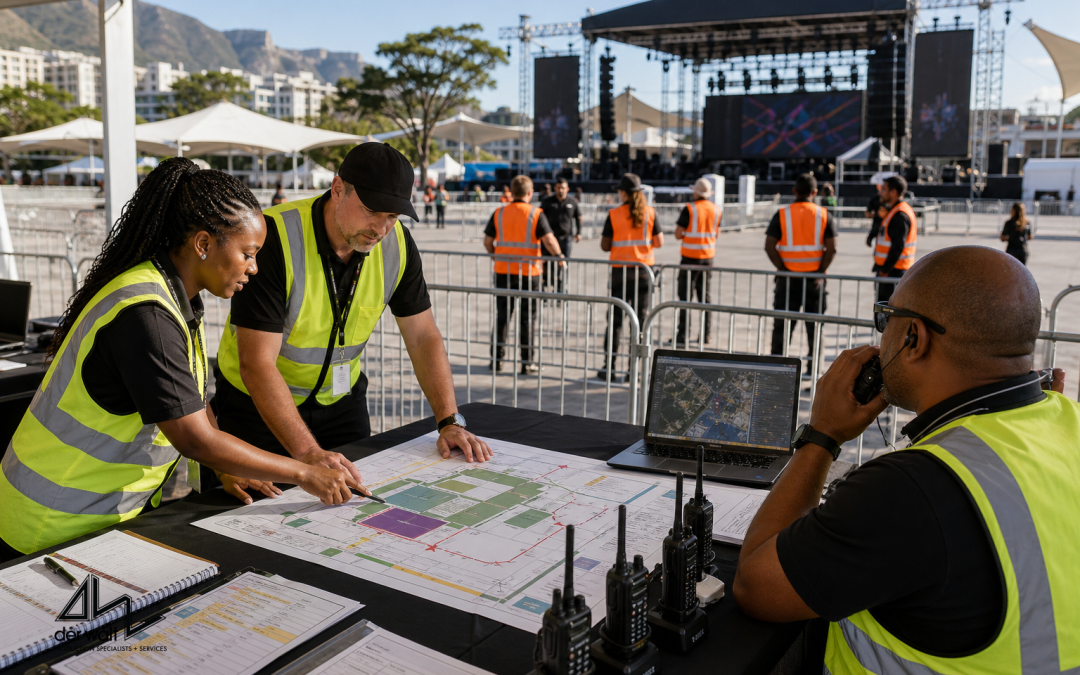
- Plan site-specific controls and operations. Create detailed site plans: crowd-flow diagrams, ingress/egress routes, barrier placements, stair configurations, VIP and staff movement, and vehicle-safety zones. Include a dedicated emergency assembly point plan and backup routes.
- Incorporate weather and environmental contingencies. South Africa’s climate varies by region and season. Build weather contingencies into your plan, including heat management, shade access, rain plans, and lightning safety protocols. Tie these to a trigger system for event modifications.
- Align with legal and regulatory requirements. Verify compliance with the Occupational Health and Safety Act where applicable, fire codes, and local municipality conditions. Ensure all permit conditions are reflected in your risk controls and communications.
- Train teams and rehearse plans. Deliver scenario-based briefings to staff and volunteers. Run a tabletop exercise or a live drill covering key emergencies, communications, and evacuation procedures.
- Communicate clearly and repeatedly. Establish multilingual, on-brand safety messages for attendees, staff, and contractors. Use visible signage, PA announcements, and mobile alerts as appropriate.
- Monitor, review, and adapt on the day. Implement a dynamic risk assessment process (a live risk check) to address new hazards or changing conditions. Maintain incident reporting and a rapid-response protocol.
On-site practices and documentation
On the day of the event, keep risk management front and center. A dedicated safety control room, a clear chain of command, and real-time communication channels (radio and digital messaging) are essential. Documentation should include:
- A current risk register with updates and owners.
- Floor plans, site diagrams, and barrier layouts that reflect any changes.
- Training records and briefing materials for staff and volunteers.
- Incident reporting forms and a defined escalation process.
Key considerations for South African events
- Hot days, thunderstorms, and sudden weather changes require robust contingency planning. The South African Weather Service is a reliable source for forecast data and weather alerts.
- Urban and peri-urban venues bring traffic management and pedestrian flow challenges. Coordinate with local authorities for road closures, shuttle routes, and signage.
- Ensure alignment with local health and safety requirements, fire safety provisions, and noise control regulations. Permit conditions often translate directly into required controls on site.
- Build realistic timelines for labour availability, especially for large teams and contractors. Use local suppliers where possible to reduce logistics risk.
- Design destinations that are navigable for people with mobility needs, language considerations, and clear wayfinding for diverse audiences.
Checklist: a quick start for your risk assessment
- Define event scope and governance structure.
- List hazards by category (crowd, structural, fire, weather, logistics, medical).
- Rate risk using likelihood and consequence; flag high-priority items.
- Select controls using the hierarchy of controls; design engineering solutions first.
- Document in a risk register; assign owners and deadlines.
- Draft site plans, ingress/egress routes, and safety zones.
- Prepare a weather contingency and communications plan.
- Ensure regulatory permits are in place and reflected in plans.
- Train staff and rehearse emergency procedures.
- Maintain live risk assessment and incident reporting during the event.
Common mistakes and considerations
- Underestimating crowd size or movement patterns—adjust models as attendance changes.
- Failing to coordinate with local authorities and emergency services—establish pre-event liaison and on-site contacts.
- Overcomplicating plans without clear ownership—assign specific responsibilities and checkpoint sign-offs.
- Ignoring weather variability—build timely, actionable weather triggers into the plan.
- Neglecting accessibility and multilingual needs—ensure signs and briefings are comprehensible to all attendees and staff.
FAQ
How early should risk assessment start for a large SA event?
Ideally as early as possible in the planning phase, continuing through to the on-day risk checks and post-event debrief.
Who should be involved in the risk assessment?
A cross-functional team including safety, operations, security, technical production, facilities, medical, and a representative from senior management or the event lead.
What if plans change last minute?
Update the risk register immediately, revise controls, communicate changes, retrain staff as needed, and resimulate critical procedures if feasible.
Which tools are essential for documentation?
A centralized risk register, site plans with labeled routes, and a clear incident-reporting process; digital tools can help with live updates on event day.
How does weather influence risk planning?
Weather affects crowd behavior, visibility, and safety of structures. Plan weather-triggered changes and maintain backup routes, shelter areas, and communication prompts.
Sources
- ISO 31000 Risk Management — International Organization for Standardization
- NFPA 101: Life Safety Code — NFPA
- South African Weather Service — Weather data and alerts for planning
- IAVM — International Association of Venue Managers safety resources
- Event Safety Alliance — Practical safety resources for event professionals
Contact DERWALT for experiential marketing, activation or event-production support
Ready to plan safe, impactful live experiences? Reach out to DERWALT for end-to-end event strategy, production management, and on-site safety coordination tailored to your activation needs.
Recent Comments