Practical Risk Management for Outdoor Brand Activations in South Africa
A formal risk management process is essential for outdoor activations in SA. Begin with a compliant risk assessment, identify hazards, apply controls, plan for weather and emergencies, and document every step for auditability.
Direct answer: Start with a formal risk assessment aligned to ISO 31000 and local SA regulations; identify hazards, assess risk, apply the hierarchy of controls, and prepare emergency plans and response procedures before any activation.
What risk management means for outdoor activations
In live environments, risk management is the deliberate, structured process of identifying what could cause harm, evaluating how likely and how serious those harms could be, and then applying measures to prevent or reduce harm. A practical risk plan keeps guests safe, protects staff, and supports smooth production.
Key terms you will hear are:
- Risk assessment: a systematic process to identify hazards, determine the risk they pose, and decide on controls. In SA, this aligns with the Occupational Health and Safety Act and local municipal regulations.
- Hierarchy of controls: a sequence of strategies to reduce risk in order of effectiveness: elimination, substitution, engineering controls, administrative controls, and personal protective equipment (PPE).
- Risk register: a living document listing hazards, risk ratings, controls, owners, and review dates.
Context: South Africa-specific considerations
Outdoor activations in SA face unique considerations. Weather can shift quickly, transport demands can spike in urban areas, and permitting often requires coordination with multiple authorities (municipality, fire services, health authorities, and security). A SA-focused risk plan should address:
- Weather variability (heat, lightning, rain, dust) and seasonal patterns.
- Public safety and crowd management, including entry/exit routes and queuing dynamics.
- Electrical safety, generator deployment, and outdoor AV installations.
- Regulatory compliance, permits, and local approvals.
- Labor considerations, vendor coordination, and site-specific hazards.
Where possible, link risk controls to recognized standards (for example, ISO 20121 for event sustainability and ISO 31000 for risk management) and cross-check with SA-specific requirements under the OHS Act and municipal by-laws.
Step-by-step: building your risk management plan
-
Include production leadership, safety officer(s), venue/site managers, security, medical services, and key suppliers. Clarify the activation’s objectives, audience size, and site boundaries. -
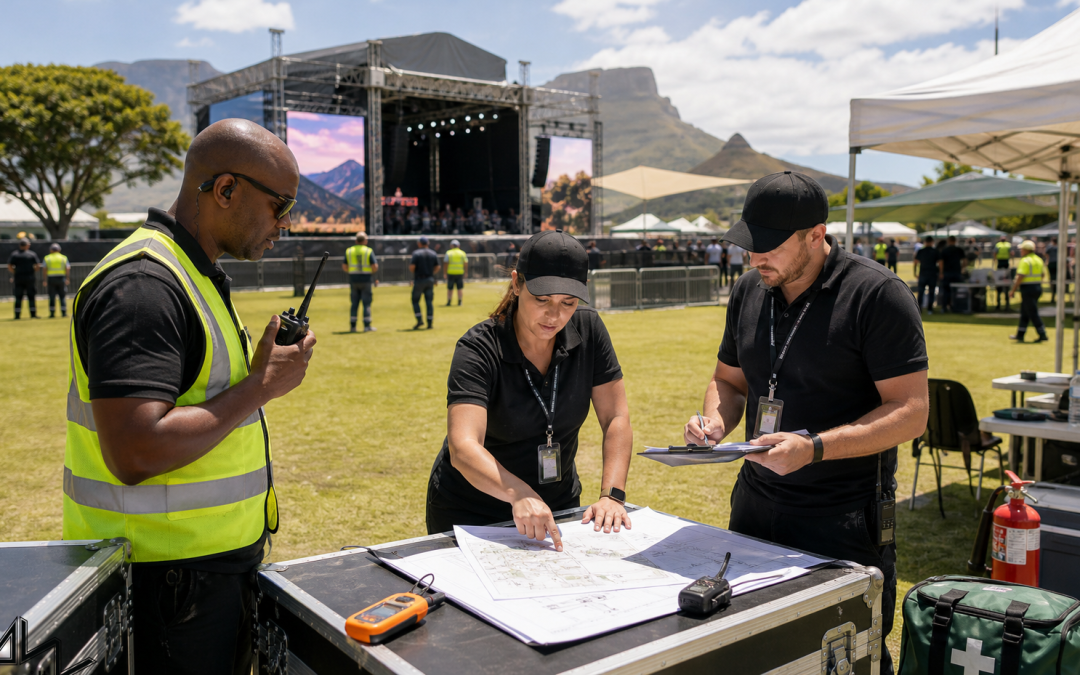
Conduct a walk-through of the venue, including stage, crowd flow, backstage areas, power distribution, food and beverage zones, and emergency egress. Consult fire, police, and EMS partners to capture their concerns. -
Use a simple matrix to rate each hazard. For example, severe weather a lightning strike carries high impact and varying likelihood, depending on season and location. Definitions: Likelihood = how probable the event will occur; Impact = potential harm to people, property, operations. A low-likelihood, high-impact hazard may still require robust controls.
-
Prioritize elimination or substitution first, then engineering controls (physical changes), administrative controls (policies and procedures), and PPE as a last line of defense. Example: relocate a generator away from crowd zones (engineering) and implement a lockout-tagout procedure during setup (administrative).
-
Create evacuation routes, assembly points, and clear communications protocols. Define roles for marshals, security, medical teams, and media liaison. -
Map required permits with timelines, including municipal event approvals, fire safety clearance, health department considerations, and traffic management if applicable. -
Confirm safety standards, site access, load-in/load-out schedules, power needs, and contingency options (backup power, alternate routes). -
South Africa’s weather can be volatile. Prepare a weather plan that includes shade, hydration stations, misting or cooling zones for heat, rain covers for equipment, and a clear lightning plan with a cut-off time for outdoor activities. -
Brief all teams and volunteers on hazards, controls, and emergency procedures. Use multilingual signage where appropriate and ensure radio/test call systems are functional. -
Maintain a live risk register, record decisions, and schedule post-event debriefs to capture lessons learned and update controls for future activations.
Weather and safety: practical planning for SA outdoor events
Weather is not optional; it’s a core variable in event planning. Prepare for heat, thunderstorms, wind, and dust, depending on the region and season. Practical actions include providing shaded areas, ample hydration, cooling zones, secure staging and rigging, and a lightning policy with a defined decision point for suspending activities.
In addition, outdoor safety relies on reliable electrical and generator management, fall protection for elevated structures, and secure crowd controls. Proactive supplier coordination ensures that back-up resources (power, shade, and first-aid stations) are available if primary systems fail.
Permits, approvals, and on-site coordination
Securing the appropriate approvals is essential to avoid delays and safety gaps. Start early with municipal permissions and fire safety clearances, then align with health authorities for any food and beverage components. On event day, a dedicated safety liaison should coordinate all on-site activities—this person acts as the single point of contact for all safety-related decisions.
Documentation: risk registers, plans, and audits
A risk register is a living document listing hazards, risk ratings, responsible owners, and controls. Regular updates, audits, and sign-offs by the risk team keep the plan current. Documentation supports safety compliance and can prove valuable during post-event reviews and future planning.
Common mistakes and considerations
- Underestimating weather impact or delaying contingency planning until the last minute.
- Failing to involve local authorities early or neglecting proper permits and clearances.
- Not aligning supplier safety practices with the event risk plan or assuming “it will be fine.”
- Inadequate emergency communication or poorly marked egress routes.
- Overlooking accessibility and special-needs considerations in crowd management.
FAQ
What is a risk assessment, and why is it essential for outdoor SA events?
A risk assessment identifies hazards, evaluates their risk, and sets out controls to prevent harm. It is essential for safety, regulatory compliance, and smooth operations in outdoor SA activations.
What should a basic risk register include?
A risk register lists each hazard, its likelihood and impact, the chosen controls, the owner, and review dates for ongoing monitoring.
How do you tailor risk controls to SA weather risks?
Assess season-specific risks (heat, thunderstorms, wind) and implement context-appropriate controls such as shade, hydration, weather-monitoring protocols, and safe shelter options for equipment and guests.
Who signs off on risk management for a major activation?
The risk plan should be reviewed and signed by the event’s responsible producers, the venue/landowner, safety officer, and relevant authorities (e.g., fire, health, municipal approvals) before staged operations begin.
What are common failure points in outdoor risk management?
Common failures include late risk assessment, poor weather planning, insufficient permits, fragmented supplier safety practices, and inadequate training or communication among staff.
Sources
- HSE: The Event Safety Guide (HSG195) — UK Health and Safety Executive
- ISO 20121: Event Sustainability Management — International Organization for Standardization
- Occupational Health and Safety Act (Act 85 of 1993) — South Africa Government
- Event Safety Alliance — Industry best practices and guidance
- International Live Events Association (ILEA) — Professional standards and resources
- South African Weather Service — Weather planning for outdoor events
Ready to plan a safe, standout activation? Contact DERWALT
DERWALT offers end-to-end production management, safety planning, supplier coordination, and on-site logistics to deliver experiential campaigns in South Africa. Reach out to discuss how we can support your activation goals with a comprehensive risk-managed approach.
Recent Comments