Planning Weather-Resilient Outdoor Events in South Africa: A Practical Guide
From sudden storms to heat waves, South Africa’s event landscape demands robust contingency planning. This guide outlines practical steps for budgeting, safety, logistics and supplier coordination to keep outdoor activations on track, compliant and memorable.
Understanding the SA context for outdoor events
Outdoor activations in South Africa sit at the intersection of vibrant culture, diverse geographies and unpredictable weather. The country’s regional climates range from arid and windy conditions in inland areas to subtropical heat along the coast, with afternoon thunderstorms in many regions becoming a common reality in warmer months. For brands and agencies, these conditions mean that a plan built on a single, perfect weather day is not a plan at all. It requires flexibility, real-time data and a decision framework that stakeholders can trust even when the forecast shifts. Reliable information sources, like the South African Weather Service, can anchor preparations, but the ultimate confidence comes from coupling forecasts with clear operational triggers and proven on-site routines.
Beyond weather, SA event planning must account for local transport realities, access control, crowd management, and emergency response. Urban venues may offer robust infrastructure, yet traffic bottlenecks, clearance times, and last‑mile logistics still require careful sequencing. In regional venues, terrain, power supply stability and shelter options shape equipment choices and vendor coordination. The practical takeaway is simple: build a plan that explicitly recognises regional variability, assigns responsibilities, and provides switch-points to move from “business as usual” to “emergency response” without friction.
Industry guidelines from reputable bodies emphasise a risk-based approach to events. Using a formal risk assessment helps identify weather-related, structural, electrical, and crowd-safety risks early, so that mitigation actions can be embedded in timelines, budgets and supplier agreements. While local regulations govern safety and permitting, the core principle—anticipate, prepare and communicate—translates globally and remains relevant for any SA activation.
Build a weather-resilient event plan from the outset
Risk assessment and contingency design
Start with a formal risk assessment that covers weather triggers, technical failures, and health-and-safety hazards. Define decision thresholds for postponement, relocation or shelter-in-place decisions, and assign a small, empowered team responsible for rapid decision-making on site. A clear decision tree helps prevent ad hoc changes that disrupt vendor schedules, audience experience and safety protocols. Documented contingencies also aid procurement teams when renegotiating contracts to include flexible change orders and weather-related allowances.
Venue and structure selection
Choose venues and structures with built-in resilience: covered or partially sheltered spaces, adaptable tents, and stage configurations that can tolerate wind loads and rainfall without compromising sound and sightlines. For semi-permanent or pop-up stages, ensure that rigging and load calculations are performed by qualified professionals and that temporary structures comply with local safety expectations. If shelter is limited, plan for alternate layouts that reduce exposure to sun and rain while preserving audience experience and sightlines for screens, stages and activations.
Power, shelter, and climate control
Power reliability underwrites safety and experience. Use weather-safe electrical installations, outdoor-rated equipment, and adequately fenced fuel storage with spill-control measures. Plan for contingency power: a backup generator or battery systems can keep critical systems (communications, lighting, medical stations) functional during outages. Create zones that separate live electrical feeds from public areas, and consider environmental controls for comfort and equipment protection—especially in heat-prone regions where heat stress can impact staff and attendees.
Communications and emergency response
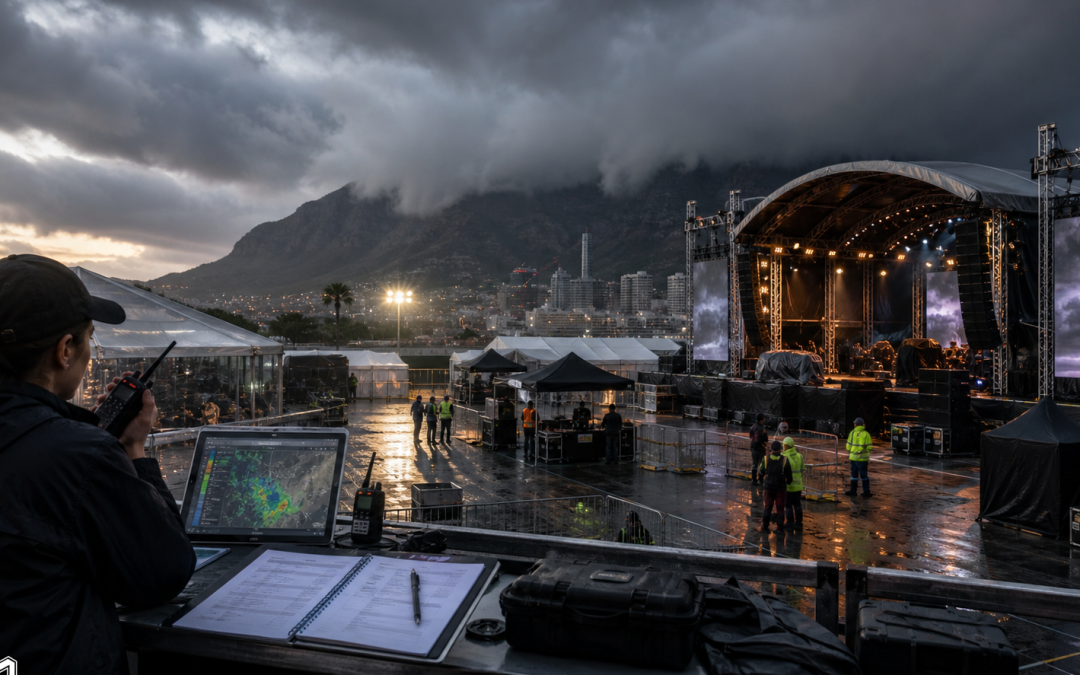
Establish a on-site control room and a clear communications protocol. Radios or secure messaging apps should connect production teams, security, medical services and venue management. Visible emergency exits, wayfinding signage, and dedicated muster points help guests respond calmly in adverse conditions. Train staff and volunteers in emergency procedures, including evacuation routes and roles during weather events, medical incidents, or crowd surges. All plans should align with recognized safety guidance to support consistent, swift action under pressure.
Budgeting for uncertainty: practical approaches
Budgeting for outdoor SA activations should explicitly reflect uncertainty. A robust plan includes a contingency line that is informed by risk assessment outcomes rather than a fixed percentage alone. Engage suppliers with flexible terms that accommodate weather-related changes—such as portable structures, scalable staffing, and adjustable timelines. Build allowance for rapid procurement or rental extensions, additional safety equipment, and enhanced medical or crowd-management resources. The aim is to prevent shortfalls from derailing the activation, while maintaining quality and compliance. Transparently communicate these contingencies to clients and internal stakeholders so that decisions stay aligned with brand objectives, risk appetite and financial governance.
Operational playbook: procurement, transport, and staffing
Local procurement is critical in South Africa, where lead times, logistics infrastructure and supplier availability vary by city and season. Identify local, reputable suppliers for tents, stages, lighting, audio, and crowd management early in the planning cycle. Sign contracts that specify delivery windows, site-ready conditions, and weather-related adaptations. Traffic planning and parking coordination should be addressed in advance, especially for inner-city venues where road closures or road works can impact access times. Staffing considerations include hydration, sun protection, shift planning, and welfare facilities for crew working outdoors in hot weather. When possible, align procurement and staffing with a single production partner who can oversee the end-to-end flow, reducing the risk of miscommunication or delays between multiple vendors.
DERWALT’s role: end-to-end support for SA activations
DERWALT brings an integrated approach to experiential marketing and event production, with capabilities spanning strategy, production management, logistics, and on-site execution. In the context of weather-resilient planning, we can support: risk assessment facilitation and contingency design, site scouting and structure planning, power and technical infrastructure management, and on-site operations that keep programs running safely and smoothly despite weather or logistic constraints. Our process emphasises clear communications, measurable safety standards, and an adaptable production timeline, so brands and agencies can focus on creativity and audience experience. Where relevant, we coordinate with trusted local suppliers and ensure alignment with South African regulatory expectations, safety practices, and crowd-management principles.
Sources
- South African Weather Service — Official weather information and forecasts for SA events
- Event Safety Alliance — Event safety guidelines and best practices
- Health and Safety Executive (UK) – Event safety — Guidance and risk management principles
- International Association of Venue Managers (IAVM) — Venue management and safety best practices
- Department of Employment and Labour, South Africa — OHS Act and compliance guidance
Contact DERWALT for your next activation
Ready to build a weather-resilient, compliant and unforgettable activation? DERWALT provides end-to-end experiential marketing and event-production support, from risk assessment and planning to on-site execution and post-event review. Contact us to discuss your SA activation today.
Recent Comments