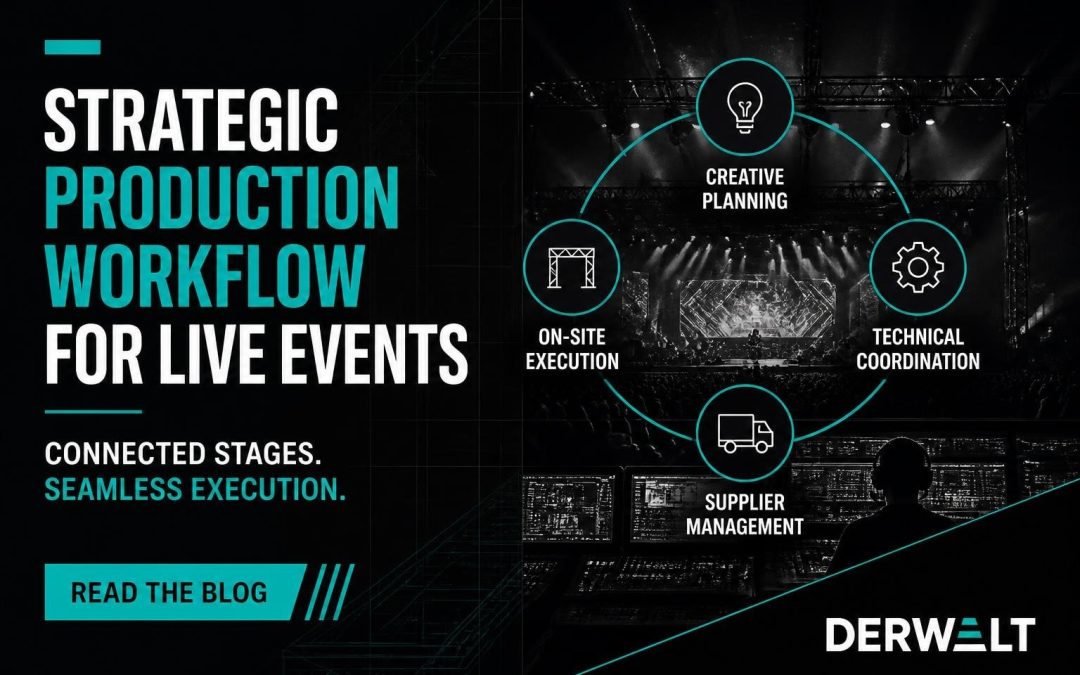
The global live events industry continues its aggressive expansion, with market projections indicating significant growth through 2030. Behind every successful brand activation, product launch, or corporate experience stands a network of specialists who transform conceptual visions into operational reality. Live event production companies serve as the critical infrastructure connecting creative ambition with technical delivery, budget accountability, and risk mitigation. For organizations investing substantial resources into brand experiences, understanding how these production partners operate has become essential for strategic decision-making.
The Architecture of Professional Event Production
Live event production companies operate across three distinct operational layers that determine project success. The strategic layer encompasses creative interpretation, concept development, and experience design aligned with brand objectives. The operational layer manages budgets, timelines, supplier networks, and resource allocation. The technical layer delivers the physical infrastructure, from audiovisual systems to staging, lighting, and power distribution.
Professional production partners distinguish themselves through production intelligence, which represents the accumulated knowledge of managing complex logistics under pressure. This intelligence manifests in accurate cost forecasting, contingency planning, and the ability to identify potential failure points before they materialize. According to live event production industry statistics, the sector's growth correlates directly with increased corporate investment in experiential marketing, making production expertise a competitive differentiator.
Service Spectrum and Specialization Models
The production landscape includes generalists handling standard corporate functions and specialists focusing on specific event categories. Large-scale music festivals require different competencies than intimate product launches or multi-day conferences. Some companies specialize in technical delivery, providing equipment and crew without creative input. Others offer full-service capabilities spanning concept creation through post-event analysis.
South African live event production companies face unique market conditions, including diverse venue infrastructure, varying technical standards across regions, and specific regulatory requirements. These factors demand localized expertise that international providers cannot easily replicate. Understanding regional logistics, from equipment sourcing in Johannesburg to venue limitations in coastal markets, separates effective producers from those who struggle with execution.
Strategic Selection Criteria for Production Partners
Choosing the right production company requires evaluating capabilities beyond portfolio presentation. Technical competency forms the foundation, but operational maturity determines whether projects stay on budget and on schedule. Review their supplier management processes, quality control protocols, and approach to contingency planning.
Request detailed breakdowns of previous project budgets and timelines. Professional companies maintain transparent cost structures and can articulate where budget allocation delivers maximum impact. Ask about their procurement practices and whether they maintain preferred supplier relationships that reduce costs or accelerate deployment.
Financial Structure and Budget Intelligence
| Budget Component | Professional Approach | Warning Signs |
|---|---|---|
| Equipment & Technical | Itemized specifications with alternatives | Vague "package pricing" |
| Labor & Crew | Detailed crew lists with rates | Bundled labor costs |
| Logistics & Transportation | Route planning with timing | Generic transportation fees |
| Contingency Allocation | Structured 10-15% reserve | No contingency discussion |
Production companies demonstrating production intelligence for brand experiences build comprehensive systems connecting every project element. This systematic approach extends beyond individual events, creating frameworks that improve efficiency across multiple activations while reducing risk exposure.
The best production partners challenge unclear briefs and ask difficult questions about objectives, audience expectations, and success metrics. They should articulate potential problems with proposed concepts and offer alternative approaches based on technical realities and budget constraints. This consultative stance indicates genuine partnership rather than simple order-taking.
Technical Infrastructure and Capability Assessment
Audiovisual technology continues advancing rapidly, with 2026 trends in live event production emphasizing LED integration, immersive audio systems, and AI-powered automation. However, cutting-edge technology means nothing without operators who understand system architecture and troubleshooting under pressure.
Evaluate production companies on their technical planning processes:
- Do they conduct site surveys before proposing solutions?
- Can they provide detailed CAD drawings and load calculations?
- How do they approach power distribution and backup systems?
- What testing protocols do they follow before event day?
- How do they handle real-time technical failures?
Supplier Networks and Vendor Management
Professional live event production companies maintain extensive supplier relationships built over years of collaboration. These networks provide access to specialized equipment, competitive pricing, and priority scheduling during peak seasons. Strong vendor relationships also enable rapid problem-solving when unexpected requirements emerge.
Ask potential partners about their event venue technical planning processes and how they coordinate multiple suppliers across staging, lighting, audio, video, catering, security, and transportation. Coordination failures between vendors represent a primary source of event complications, making integration management a critical competency.
Risk Mitigation and Operational Excellence
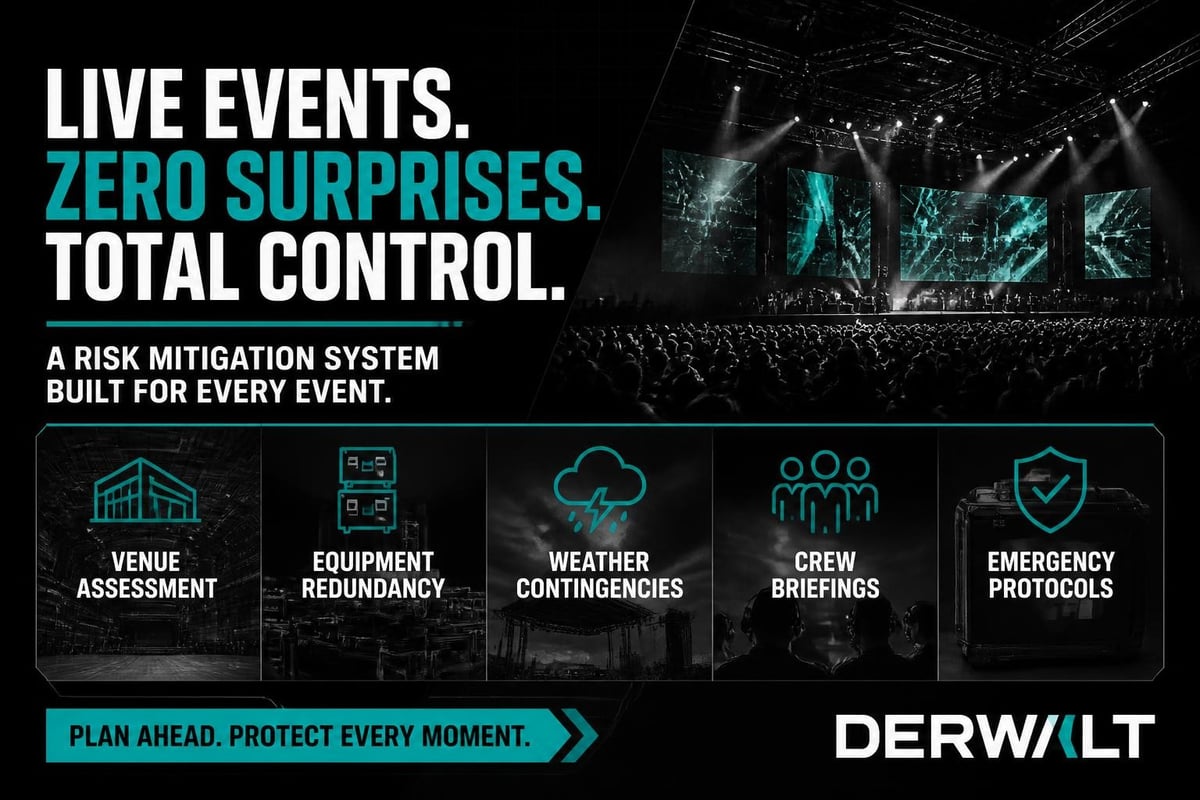
The difference between adequate and exceptional production partners becomes visible under stress. Weather disruptions, equipment failures, talent cancellations, and venue emergencies test operational resilience. Companies with robust risk management frameworks identify vulnerabilities during planning and build layered contingencies.
Review their approach to health and safety compliance, particularly for large event planning scenarios. Professional producers maintain documented safety protocols, conduct pre-event risk assessments, and coordinate with local emergency services when appropriate.
Insurance requirements also indicate operational maturity. Established production companies carry comprehensive liability coverage, equipment insurance, and professional indemnity policies. They should readily provide certificates of insurance and explain coverage limits without hesitation.
Communication Protocols and Project Management
Clear communication structures prevent the confusion that derails complex projects. Professional production companies assign dedicated project managers who serve as single points of contact throughout the engagement. They maintain structured communication schedules, provide regular status updates, and document all decisions in writing.
Examine their project management tools and reporting formats. Do they use collaborative platforms for real-time updates? How do they handle change requests and scope modifications? What documentation do they provide post-event? These operational details reveal whether they operate systematically or reactively.
Technology Integration and Innovation Capacity
The production landscape increasingly incorporates digital technologies that enhance experiences and improve efficiency. Cloud-based live production platforms enable remote collaboration and reduce setup complexity, while AI integration in live events automates transcription, translation, and even camera operations.
However, technology adoption should align with strategic objectives rather than novelty. Evaluate whether production companies recommend technology because it solves specific problems or simply because it's trendy. The best partners balance innovation with reliability, introducing proven solutions while maintaining fallback options.
Hybrid Event Capabilities
Post-pandemic market dynamics have permanently embedded hybrid formats into corporate event strategies. Production companies must now seamlessly integrate physical and virtual elements, managing both in-person audiovisual requirements and broadcast-quality streaming. This demands expertise in encoding, content delivery networks, virtual engagement platforms, and audience interaction tools.
Ask about their experiential event production approach for hybrid formats. How do they balance resources between physical and digital audiences? What platforms do they recommend for different audience sizes? How do they measure engagement across both channels?
Sustainability and Environmental Responsibility
Corporate sustainability commitments increasingly influence production decisions, with brands demanding measurable environmental impact reduction. Forward-thinking live event production companies implement sustainable practices spanning energy consumption, waste management, transportation optimization, and material sourcing.
Sustainable event production benchmarks demonstrate significant emissions reductions through systematic planning. Production partners should articulate their sustainability policies and provide data on waste diversion rates, renewable energy usage, and carbon offset programs.
Consider their approach to these specific areas:
- LED technology adoption for reduced power consumption
- Reusable staging and set design elements
- Digital alternatives to printed materials
- Local supplier prioritization to minimize transportation
- Post-event material recycling and donation programs
Creative Collaboration and Concept Development
While technical execution and logistics management form the operational foundation, creative collaboration determines whether events deliver memorable brand experiences. The best production companies contribute strategic thinking during concept creation phases, challenging briefs constructively and offering alternatives grounded in production realities.
Evaluate their creative process structure. Do they conduct discovery workshops to understand brand positioning and audience expectations? How do they translate strategic objectives into experiential concepts? Can they demonstrate how creative ideas connect to measurable business outcomes?
Experience Design and Audience Engagement
Professional producers understand that technical excellence serves strategic experience design. Every lighting cue, audio transition, and visual element should advance the narrative and reinforce brand messaging. This requires collaboration between creative directors, technical directors, and brand stakeholders throughout development.
Review their portfolio not just for visual impact but for strategic coherence. Can they articulate the business objectives behind showcase projects? Do they measure success beyond execution quality to include audience response and brand impact? This strategic perspective separates production vendors from genuine partners.
Regional Considerations and Market Knowledge
Operating across South Africa's diverse markets requires understanding regional variations in infrastructure, supplier availability, venue standards, and logistical complexity. Production companies claiming national capability should demonstrate actual experience across multiple regions, not just presence in major metros.
Geography significantly impacts production budgets and timelines. Equipment transport from Johannesburg to Cape Town adds costs and complexity that experienced producers factor into planning. Venue coordination expertise specific to local markets prevents costly surprises and timeline disruptions.
| Regional Factor | Impact on Production | Mitigation Strategy |
|---|---|---|
| Venue Infrastructure | Technical limitations vary significantly | Advance site surveys and equipment staging |
| Supplier Density | Limited options outside major metros | Early booking and backup procurement |
| Transportation Logistics | Distance affects costs and timing | Route optimization and consolidated shipping |
| Local Regulations | Compliance requirements differ regionally | Regional partner networks and permit expertise |
Post-Event Analysis and Continuous Improvement
Professional production partnerships extend beyond event day execution to include comprehensive post-event analysis. This debriefing process captures lessons learned, identifies improvement opportunities, and documents successful approaches for future reference. Companies that invest in this analysis demonstrate commitment to continuous improvement.
Request examples of post-event reports from previous projects. What metrics do they track? How do they gather stakeholder feedback? Do they conduct technical audits to identify equipment performance issues or crew training needs? This documentation becomes invaluable for organizations managing multiple events annually.
The most valuable production partners view each project as part of an ongoing relationship rather than isolated transactions. They maintain institutional knowledge about client preferences, brand standards, and successful approaches, enabling efficiency gains across multiple activations.
Strategic event production requires more than equipment and crew. It demands systematic planning, technical expertise, risk intelligence, and operational discipline that transforms creative visions into flawless brand experiences. Whether executing product launches, corporate conferences, or large-scale activations, partnering with experienced producers protects investments and maximizes impact. DERWALT delivers this comprehensive production intelligence across South Africa, providing the strategic planning and technical execution infrastructure that drives successful brand experiences from concept through delivery.
Recent Comments