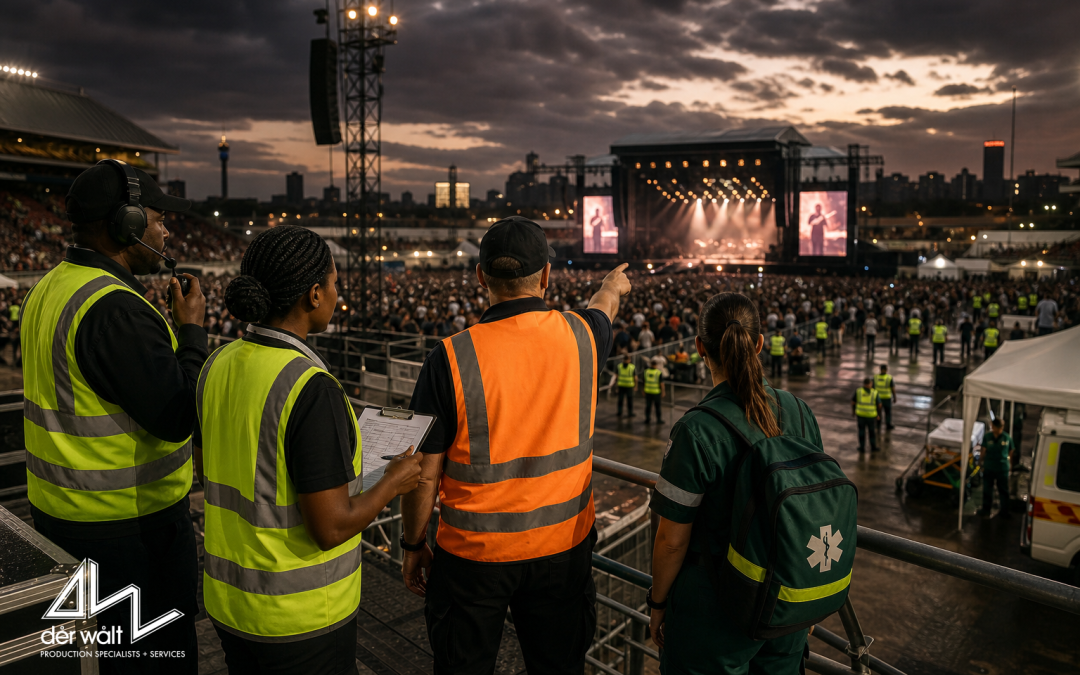
How to Safely Scale Large-Scale Events in South Africa: A Practical Safety Plan
Develop a risk-based safety plan aligned to South Africa’s OHSA and SASREA, plus venue rules, to scale live experiences with confidence. This guide provides actionable steps for production teams, brands and agencies.
Direct answer
A scalable, safe large-scale event in South Africa starts with a risk-based Safety Management Plan that aligns with the Occupational Health and Safety Act (OHSA) and the Safety at Sports and Recreational Events Act (SASREA). This plan is supported by a site-specific hazard assessment, a formal Safety Management System (SMS), trained safety personnel, and rehearsals with stakeholders to validate procedures in real conditions.
Context: why safety planning matters in South Africa
South Africa’s regulatory framework emphasises proactive hazard identification, documented control measures and clear incident reporting. OHSA requires employers to provide a safe working environment, while SASREA focuses on safety for spectators, athletes and event staff at sports and recreational events. Beyond compliance, well-executed safety planning protects audiences, staff and brand reputation, helps achieve smoother operations, and reduces postponements or cancellations that can derail a project’s timeline and budget.
Practical guidance: core components of a safety plan for large events
1) Start with a robust risk assessment
Build a structured risk assessment that covers all phases of the event—from planning and load-in to post-show wrap. Identify hazards across categories such as crowd dynamics, stage and rigging, electrical systems, fire safety, medical access, weather, traffic and transport, access control, and maintenance of temporary structures. Use a proven method (for example, what-if analysis or bow-tie diagrams) to map detected hazards to specific barriers or mitigations.
2) Create a site-specific Safety Management System (SMS)
Documented procedures should include roles and responsibilities, chain-of-command, emergency response workflows, communication protocols, and incident reporting. The SMS should be dynamic: updated after rehearsals, drills, and any incident, with a clear mechanism for operators, security and venue teams to share updates in real time.
3) Establish a dedicated safety team and clear lines of accountability
Appoint a Safety Manager or Safety Officer with overall authority, plus on-site roles for crowd management, medical services, fire safety, electrical safety, security, and logistics. Ensure all teams have pre-event briefings and access to a single source of truth (a safety plan binder or digital dashboard).
4) Crowd management and audience experience
Plan entry/egress routes, queuing, wayfinding, and barrier layouts to minimize bottlenecks and reduce the risk of crushing or overcrowding. Use signage with simple, multilingual instructions. Consider accessibility needs and ensure safe zones for families, elderly attendees, and people with disabilities.
5) Stage, rigging and technical safety
Engage qualified riggers for all temporary structures, lighting trusses and audio systems. Regularly inspect rigging hardware, lifting points, and power distribution. Keep a clear separation between technical zones and audience spaces, and enforce safe exclusion zones during load-in and load-out.
6) Electrical safety and generators
Develop a power distribution plan with step-by-step isolation procedures, weatherproofing for outdoor events, and fuel management for generators. Establish clear fueling and refueling protocols, correct cable management, and emergency shut-off procedures. Use appropriate residual current devices (RCDs) and regularly test electrical equipment.
7) Fire safety and emergency egress
Implement fire detection, suppression equipment, and clearly marked exits. Conduct routine drills and ensure staff know where fire extinguishers, muster points and emergency exits are located. Maintain unobstructed egress routes even during peak crowd load.
8) Medical access and emergency response
Position medical tents or clinics strategically with visible access routes for ambulances. Pre-arrange transport and communication with local emergency services. Provide trained first responders, basic life support and rapid communication channels for on-site staff.
9) Security, access control and stakeholder coordination
Coordinate with security teams and local authorities early. Define controlled access points, bag checks, and contra-flow patterns to prevent unauthorised entry and ensure spectator safety. Establish a clear incident reporting protocol that can be activated in seconds.
10) Transportation, parking and site circulation
Map drop-off zones, public transport access, taxi ranks and parking with signposted routes. Implement traffic control plans, marshal points and pedestrian barriers to prevent vehicle-pedestrian conflicts near the venue.
11) Permitting, permissions and local context
Identify and obtain all required permits and approvals well in advance. Coordinate with the venue, local authorities and event regulators to align safety requirements with site rules and community expectations. In South Africa, ensure compliance with OHSA and SASREA as part of your planning and documentation.
12) Weather planning and contingency measures
Outdoor events require weather contingencies for heat, rain, wind and lightning. Develop shelter plans, wind thresholds for structural elements, rain plans for stages and electrical protection, and communication plans to inform attendees of changes.
13) Sustainability and responsible operations
Integrate waste management, energy use optimization and recycling into the safety plan. Use energy-efficient lighting and renewable options where feasible, and ensure safe handling of hazardous materials or temporary infrastructure debris.
Practical checklist: timeline and responsibilities
- 6–8 weeks before: complete initial risk assessment; draft the SMS; assign safety roles; begin permit dialogue.
- 4–6 weeks before: confirm venue-specific safety requirements; finalize crowd management plan; establish medical access and security coordination.
- 2–3 weeks before: conduct site walk-through with riggers, electrical teams and security; rehearse safety procedures with all staff.
- 1 week before: run a full safety drill or tabletop exercise; verify emergency communications and muster points.
- Event day: operate with the SMS live, monitor conditions, and execute the pre-planned emergency response if needed.
- Post-event: capture learnings, update the SMS, and share incident logs with stakeholders.
Common mistakes and considerations
- Under-resourcing safety: insufficient safety staff or delayed risk reviews lead to avoidable risk.
- Overlooking weather contingencies: failing to plan for heat, rain or wind can compromise structures and attendee safety.
- Slow or unclear communications: delays in alerting teams or attendees can escalate incidents.
- Inadequate access and egress planning: poorly designed crowd flows create bottlenecks and hazards.
- Treating safety as a one-off task: ongoing monitoring, drills and plan updates are essential to maintain safety throughout the event lifecycle.
FAQ
What is a Safety Management Plan (SMP) and why is it essential?
An SMP documents roles, procedures, risk controls and communication for all safety-related activities, providing a single source of truth to guide the event team from planning to wrap.
How early should risk assessments be completed for a large SA event?
As early as possible, ideally during concept development, and updated after each major planning milestone, rehearsals or drills.
What regulatory frameworks should I reference in South Africa?
Key frameworks include the Occupational Health and Safety Act (OHSA) and the Safety at Sports and Recreational Events Act (SASREA), plus venue-specific requirements and local permits.
How do I test safety plans before the event?
Conduct site walk-throughs, tabletop exercises and full or partial safety drills with all teams, then refine procedures based on feedback and observed gaps.
What role does weather play, and how can I mitigate its impact?
Weather can directly affect crowd safety and structure stability; mitigate with contingency plans, shaded or cooled spaces, rain covers, and clear communication to attendees.
How can DERWALT support safety-driven event delivery?
DERWALT can translate audience activation goals into a practical safety-forward production plan, coordinate risk assessment processes, and provide experienced production and logistics support to ensure safe, impactful live experiences.
Sources
- Occupational Health and Safety Act (SA) — Government of South Africa — Government
- Safety at Sports and Recreational Events Act (SASREA) — Government of South Africa — Government
- Event safety toolbox — UK Health and Safety Executive — HSE
- NFPA 101 Life Safety Code — NFPA
- ISO 20121:2012, Event sustainability management — International Organization for Standardization
Call to Action
If you’re planning a large experiential activation or live event in South Africa and want a safety-focused, production-driven partner, reach out to DERWALT. We blend event strategy, production management and logistics to deliver immersive experiences with robust safety, efficiency and impact.
Recent Comments