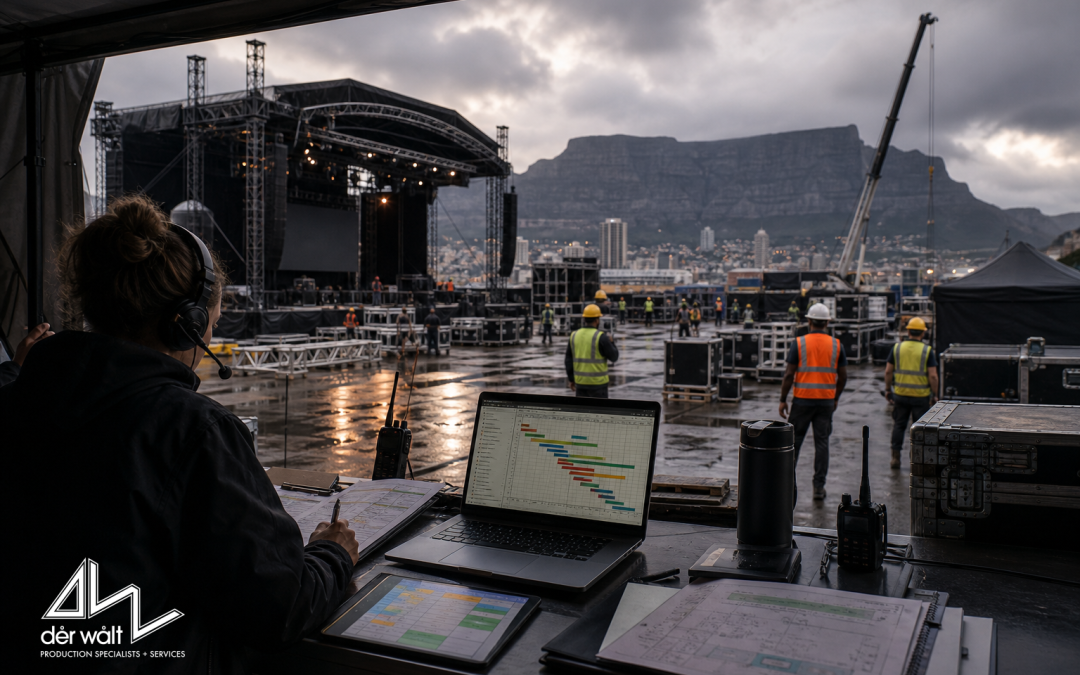
Creating a Resilient Production Schedule for Large-Scale Live Events in South Africa
A practical guide for brands, agencies and venues in South Africa to design production schedules that stay on track despite weather, power, transport and permitting uncertainties. Learn a modular, risk-aware approach you can implement now.
Primary search intent: How can brands and event teams plan a resilient, scalable production schedule for large-scale live events in South Africa? Answer: Build a modular schedule with clear dependencies, built-in buffers, and a risk-based approach to supplier coordination, weather, power and permitting realities specific to South Africa.
Direct answer: a resilient scheduling framework you can implement
The most effective way to plan a large event in SA is to adopt a modular, risk-aware scheduling framework that keeps the critical path visible, allocates deliberate buffers, and synchronises all suppliers and site activities. This approach reduces the chance of last-minute overruns while preserving quality, safety and the audience experience.
Context: why resilience matters for SA live events
South Africa presents a unique combination of variables that can affect production timelines. Weather can shift quickly across regions, power supply may fluctuate, and transport or access to venues can be affected by peak traffic or load-shedding schedules. Permitting and compliance processes often involve multiple local authorities and site-specific approvals. In addition, coordinating a diverse set of suppliers—rental houses, technical crews, security, catering and transport—requires clear interfaces and documented responsibilities. A resilient schedule recognises these realities and keeps teams focused on the critical path without becoming overwhelmed by non-critical tasks.
The goal is not to eliminate uncertainty, but to manage it. A resilient plan anticipates disruption, provides alternatives, and enables rapid replanning. When teams align around a shared calendar, dependencies become obvious, and decision points—such as when to stage production gear, when to secure permits, and when to conduct site tests—occur on known dates with clear owners.
Practical guidance: a step-by-step framework for SA-scale activations
- Define the master objective and critical path. Start with the end-to-end experience and identify tasks that, if delayed, would push the event past its go-live time. Map them onto a single master schedule that includes pre-event build, event-day operations and post-event wrap.
- Segment the plan by precincts or zones. Break the venue or site into logical areas (e.g., stage, audience zones, back-of-house, sponsor zones). This clarifies responsibilities, reduces cross-area constraints, and makes parallel workstreams feasible.
- Build buffers and flexible milestones. Attach buffers to high-risk activities (permits, power delivery, crane lifts, large-scale rigging) and keep non-critical tasks on separate lanes. Buffers should be tailored to risk level, local conditions, and vendor performance history.
- Create a robust procurement and vendor plan. Maintain a short list of preferred local suppliers and backup options. Document lead times, delivery windows and a fallback plan for each major item (rigging, LED walls, generators, stages, sound systems). Ensure contact points and escalation paths are present.
- Incorporate safety, compliance and risk management from day one. Build a risk register with likelihood and consequence for each significant hazard, and attach control measures. Align with applicable safety standards and South African guidelines for live events.
- Plan rehearsals, site tests and contingency drills. Schedule technical run-throughs, risk-reduction tests and emergency drills well before doors open. Use these to validate timing, capacity and crew readiness, and to refine the master schedule.
- Implement a live-monitoring framework. On event days, use a single command-and-control point for schedule changes, weather observations, transport updates and incident reporting. A digital dashboard helps everyone stay aligned.
Key considerations for delivery and logistics
- Weather planning. Use the South African Weather Service forecasts and local microclimate data for each venue. Prepare contingency weather plans, including sheltered staging options, contingency power uptime and wind-safe rigging practices.
- Power and load management. Map power requirements to generator capacity, battery backup, and grid contingencies. Plan fuel buffers and remote refueling logistics in case of extended outages.
- Permits and permissions. Build a permit calendar early, including health and safety approvals, public-safety waivers, noise restrictions, and traffic management plans. Engage authorities with ample lead time and keep a transparent trail of documents.
- Transport and access. Account for peak travel patterns, venue loading bays, crane and truck access, and potential road closures. Schedule staggered deliveries to reduce congestion and ensure on-time arrivals.
- Crew management and labour. Align shifts with union or labour regulations where applicable. Build buffer days around relocation or rigging windows, and confirm on-site crew accommodations and transport options in advance.
- Sustainability and waste. Integrate a plan for waste reduction, recycling, and responsible sourcing to align with broader brand goals and stakeholder expectations.
Practical tools: templates, checklists and workflows
- an at-a-glance view of critical path tasks, owners and dates.
- risk register: categorised by risk type (weather, safety, supply), with mitigation actions and owners.
- vendor lead-time matrix: maps each major element to its procurement window and fallback options.
- site-specific run-of-show: a detailed, zone-based plan for load-in, build, rehearsals and show sequence.
Common mistakes and how to avoid them
- Underestimating lead times. Vendors and authorities often need more time than anticipated. Build in extra weeks for permits and equipment delivery.
- Overloading the master schedule. Too many tasks in one timeline obscure the critical path. Keep the master calendar focused on the essential milestones first.
- Buffer neglect. If buffers are only on a few tasks, a single disruption can cascade. Distribute buffers by risk level across multiple workstreams.
- Insufficient contingency rehearsals. Real-world testing reveals timing and safety gaps that planners don’t see on paper. Schedule practical drills.
FAQ
What is the critical path in event production scheduling?
The critical path comprises tasks that directly determine the event’s start time. Delays here push the entire show back, so these tasks require the most attention, visibility and contingency planning.
How much buffer should be built into a production schedule?
Buffer should be proportional to risk: higher-risk elements get larger buffers. Treat buffers as date cushions on the calendar, not as optional time; they absorb delay without affecting the end date.
How can we plan for weather and power constraints in SA?
Combine weather forecasts with flexible staging configurations and backup power options. Prepare alternative plans for outdoor segments, and verify generator capacity and fuel logistics well in advance.
How do we coordinate with multiple suppliers and crews efficiently?
Use a single point of contact, a shared schedule, and a digital collaboration tool. Establish clear interfaces, escalation paths and regular status updates to minimize hand-off delays.
What safety considerations should be baked into the plan?
Develop a risk register, implement site-specific safety plans, and ensure compliance with relevant standards. Conduct pre-event safety briefings and drills, and ensure emergency response protocols are clear and practiced.
Sources
- OSHA — Occupational Safety and Health Administration — United States
- ISO 20121: Event sustainability management system — International Organization for Standardization
- South African Weather Service — National weather data and planning
- Event Safety Alliance — Event safety guidance and best practices
- NFPA — Fire and life safety standards
Ready to elevate your SA live experiences with DERWALT
If you’re planning a large-scale activation or a multi-city live event, DERWALT offers end-to-end experiential marketing, activation and event-production support in South Africa. Let’s design a resilient production schedule and a safe, seamless show together.
Recent Comments