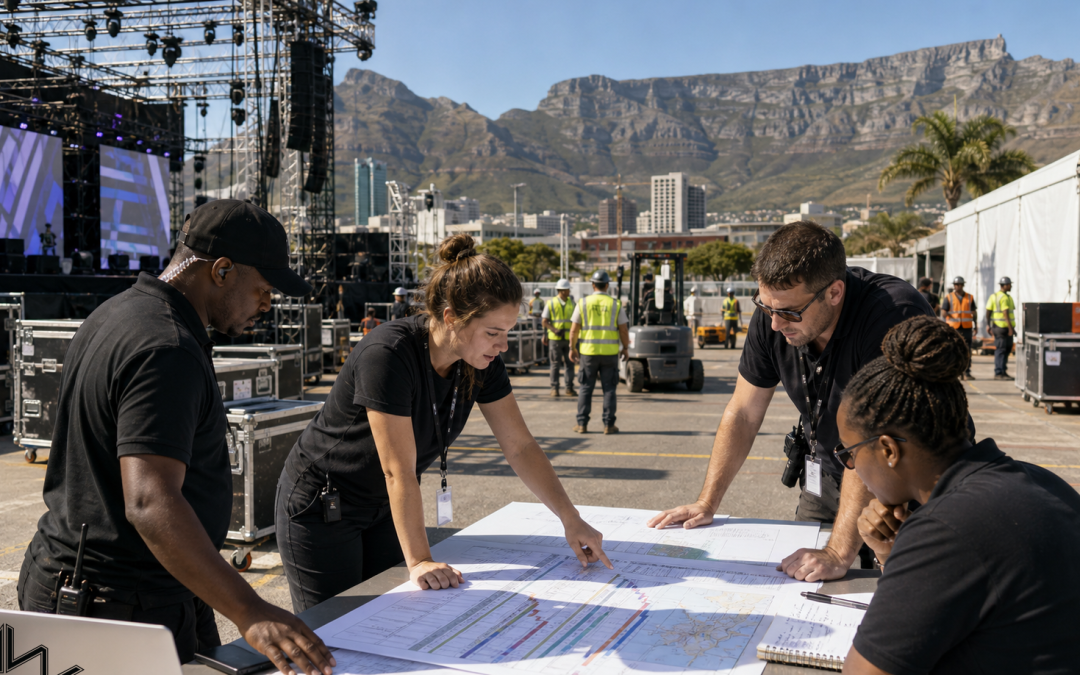
Building a Resilient Production Schedule for South African Activations
Learn how to design a risk-aware production timetable for large experiential events in South Africa. From weather buffers to permit lead times, this guide outlines practical steps to keep activations on track and within budget.
Direct answer: Build a master schedule anchored to the project’s critical path, then insert deliberate buffers for weather, power, permitting, and transport. Review and adjust weekly with suppliers, venue, and client stakeholders.
Context: why risk-adjusted scheduling matters for SA activations
Experiential productions in South Africa involve coordination across venues, public spaces, and multiple municipal authorities. Weather can be unpredictable, especially in summer regions, and load-shedding requires contingency planning for power. Permitting timelines vary by city, and traffic or road conditions can affect load-in and guest flow. A risk-adjusted schedule helps teams anticipate these realities rather than react to crises.
Practical steps to build a resilient schedule
Step 1: Define scope and milestones
Document what the activation includes (content, staging, AV, branding, guest zones) and set non-negotiables such as site handover, rehearsals, and showtime. Attach owners and clear sign-off processes to each milestone.
Step 2: Map dependencies and the critical path
Use the Critical Path Method (CPM) to identify tasks that determine the project duration. Any delay on a critical task pushes the entire schedule, so you must monitor these tasks closely. Critical path refers to the sequence of dependent tasks that dictates the minimum project duration.
Step 3: Build buffers for weather, power, and transport
Buffers absorb uncertainty. For outdoor activations, reserve extra setup days or flexible spaces; for power, plan generator redundancy and fuel stock; for transport, build in contingency for traffic, vehicle availability, and last‑mile delivery windows. Include explicit owner and trigger points for using buffers.
Step 4: Plan permits and compliance windows early
Permit approvals and safety plans can vary by city. Start with municipal permissions, road closures, and safety documentation well in advance, and embed a permit calendar into the master schedule. Assign a permit liaison to manage status updates and renewals.
Step 5: Align local suppliers and logistics
Create a supplier matrix with lead times for power, rigging, staging, AV, catering, and security. Confirm access times, labour availability, and backup options. A single point of contact for critical suppliers keeps alignment tight.
Step 6: Establish a weekly risk-review cadence
Maintain a risk log with probability, impact, and mitigations. Run a weekly stand‑up with core teams to adjust timelines, reallocate buffers, and communicate changes to clients and stakeholders.
South African context: practical considerations that shape the schedule
- Load shedding and contingency power: plan for generators, fuel management, and on-site charging stations for critical AV and lighting.
- Weather patterns: summer thunderstorms or localized rain can disrupt rehearsals or load-ins; build flexible days and sheltered spaces.
- Permitting and city processes: each city may have different road-closure and public-space rules; begin applications early and maintain a shared permit tracker.
- Local labour and procurement: coordinate with registered local suppliers to ensure compliance with labour laws and safety standards; consider B-BBEE and localisation where relevant.
- Transport and access: plan routes around peak traffic, ensure driver briefings, and have contingency plans for last-minute access changes.
Quick reference checklist
- Clear scope and milestones with owners assigned
- CPM-derived critical path identified
- Weather, power, and transport buffers defined and triggered when needed
- Permits calendar created and monitored
- Local suppliers engaged with agreed lead times and backups
- Weekly risk review cadence established
Common mistakes and how to avoid them
- Underestimating permit lead times: start early and assign a dedicated permit contact.
- Ignoring weather risk for outdoor activations: treat weather as a first-class driver of the schedule with explicit buffers.
- Overloading the critical path without buffers: ensure buffers exist not just in time but in budget and resources.
- Failing to align suppliers: maintain a single point of contact and a living schedule accessible to all key partners.
- Infrequent risk reviews: schedule weekly reviews to catch issues before they disrupt the plan.
FAQ
What is a risk-adjusted schedule?
A schedule that includes time and resource buffers for known uncertainties (weather, power, permits, transport) and a formal plan to address them if they arise.
How far in advance should permits be secured in SA?
Start as early as possible—ideally months before outdoor activations—because city processes vary and delays can cascade into the build timeline.
What buffers are typical for SA events?
Buffer needs depend on location and scope, but common practice is to insert weather and access buffers of several days for load-in/out, plus contingency for permit and power contingencies.
What tools help manage the schedule?
Gantt-style project tools (like MS Project, Smartsheet, or Excel calendars), a risk log, and a shared calendar for core teams help maintain visibility and alignment.
Is ISO 20121 relevant to scheduling?
Yes. ISO 20121 provides a structured framework for event sustainability and governance, including how to manage schedules, risks, and stakeholder engagement effectively.
Sources
- ISO 20121: Event sustainability management systems — ISO
- Event Safety Alliance — Event Safety Alliance
- IAVM — International Association of Venue Managers
- Health and Safety Executive (UK) — UK HSE
Work with DERWALT
Ready to translate a resilient production schedule into a fully delivered experiential activation? DERWALT partners with brands and agencies to plan, manage, and execute end-to-end event production, from strategic scheduling and safety planning to on-site logistics and content creation. Let us help you turn complex logistics into seamless live experiences.
Call to action
Partner with DERWALT for experiential marketing, activation or event-production support. Contact us to discuss your next large-scale activation and how we can help you deliver a flawless, safe and sustainable live experience.
Recent Comments