Building a Practical Safety Plan for South African Live Events
A practical, action-oriented guide to risk assessment and safety planning for large-scale live events in South Africa. Learn a four-step framework plus weather, crowd management and on-site coordination to deliver safe activations.
Direct answer: Use a four-step risk framework—identify hazards, assess risk, implement controls, and monitor—paired with a site-specific safety plan that covers weather contingencies, crowd management, transport, and supplier coordination for South African outdoor events.
Why a formal safety plan matters for South African live events
Large activations in South Africa involve diverse hazards—from weather volatility and high heat to urban traffic congestion and dense crowd movement. A formal safety plan helps ensure regulatory compliance, stakeholder alignment, and a smoother on-site experience for attendees, staff and performers.
Foundational framework: four-step risk management
- Identify hazards and gather input from venue owners, local authorities, production teams and security partners. Consider weather, fire, crowd dynamics, infrastructure, electrical, and medical factors.
- Assess risk in terms of likelihood and severity. Use a simple matrix to rate each hazard (low, medium, high) and determine tolerable risk levels for the event’s specific context.
- Implement controls to reduce risk to tolerable levels. Prioritise eliminating hazards where possible, then engineering controls, administrative procedures, and personal protective equipment as needed.
- Monitor and review continuously. Reassess as plans evolve, weather changes, or new partners come on board; document lessons learned for future events.
Core components of a South Africa–oriented safety plan
A practical safety plan for SA events combines regulatory alignment, site-specific logistics, and clear ownership. The plan should be a living document used from early planning through on-site execution and post-event debriefs.
Regulatory alignment and approvals
Ensure you understand local permitting requirements, fire safety approvals, occupancy limits, and emergency access. In many municipalities, a risk assessment and site plan must be submitted for approval weeks before the event date.
Site mapping and egress design
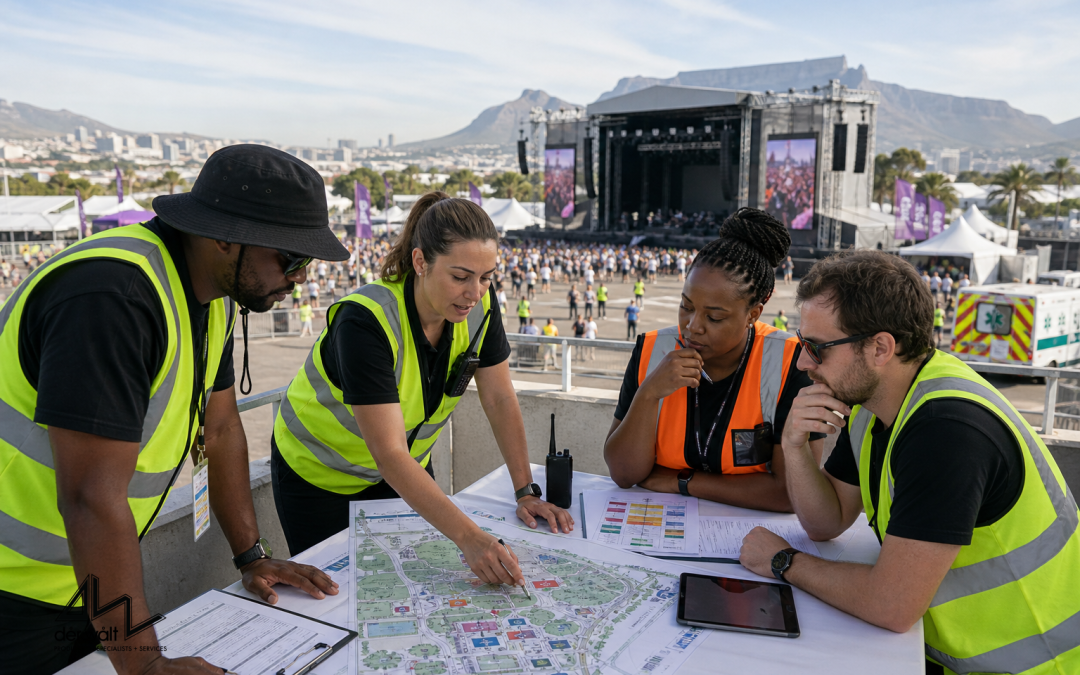
Create a detailed site plan showing entry and exit points, crowd flow routes, muster points, and access for emergency services. Map locations for medical tents, information desks, lost-and-found, and staff staging areas.
Weather contingency planning
South Africa’s weather can be volatile, especially in coastal and inland regions during summer. Forecasts should be checked daily leading up to the event, with defined thresholds for wind, lightning, heat, and rain that trigger delays or evacuations.
Crowd management and communication
Assign trained stewards and supervisors to key zones. Establish clear, multi-channel communications (radios, loudspeakers, digital signage) and language-accessible announcements to direct attendees calmly during emergencies.
Personnel, roles and responsibilities
Document who does what on event day: safety officers, medical responders, operations managers, transport coordinators, security leads, site stewards, and volunteers. Ensure everyone has a copy of the safety plan and a quick-reference card with escalation steps.
Medical and emergency response
Plan for first aid, ambulance access, patient pathways, and rapid evacuation routes. Confirm proximity to local hospitals and set up a medical hub within easy reach of high-traffic zones.
Vendor and supplier coordination
Coordinate with electricians, rigging crews, stage managers, and concession operators. Establish pre-event checklists, site induction requirements, and a single point of contact for on-site changes.
Security and access control
Implement layered security: perimeter fencing, controlled entry points, credential checks, bag screening where appropriate, and incident reporting protocols. Ensure alignment with local law enforcement and venue policy.
Sustainability and accessibility considerations
Integrate responsible waste management, energy efficiency, and inclusive access provisions (ramps, seating, and clear wayfinding) into the safety plan to support broader event goals.
Practical guidance: templates and checklists you can use
Use lightweight, field-ready tools that speed up planning without sacrificing safety. The following templates help keep your plan actionable and auditable.
1) Hazard log and risk register
A living document listing each hazard, its risk rating, existing controls, and additional mitigations. Include responsible owner and target completion dates.
2) Site and evacuation plan template
A scaled map showing entry points, exits, muster locations, medical tents, and vehicle access. Include emergency assembly points and pedestrian routes with signage guidance.
3) Communications and command plan
Define who communicates what, when, and through which channels. Pre-load key messages for different scenarios (weather delays, evacuations, medical emergencies) and specify notification cadence.
4) Weather and safety decision matrix
A simple matrix linking weather thresholds to concrete actions (delay, partial shutdown, full evacuation) so decisions are transparent and timely.
Common mistakes and key considerations in SA contexts
- Underestimating weather impact, especially in coastal zones where sudden storms can disrupt outdoor stages.
- Failing to secure emergency vehicle access routes and clear on-site muster points, risking delayed medical response.
- Overlooking language diversity and accessibility needs in announcements and wayfinding.
- Relying on a single safety contact; ensure backups and cross-training for critical roles.
- Neglecting post-event debriefs to capture learnings and update risk registers for future events.
FAQ
What is the first step in creating a safety plan for a large SA event?
Begin with a hazard identification exercise that pulls input from all key stakeholders and venue owners to build a comprehensive risk register.
How often should a safety plan be reviewed?
Review and update the plan at least monthly during planning, after major partner changes, and immediately after any rehearsal or small incident on-site.
What local resources should I consult for SA event planning?
Consult the local municipality, fire department, health and safety authorities, and weather services, plus national standards bodies such as ISO for sustainable practices.
How can I ensure accessibility within the safety plan?
Incorporate inclusive access routes, clear signage, staff trained in assisting people with disabilities, and quiet zones for attendees requiring special accommodations.
What should a weather contingency include?
Define trigger points for delays or evacuations and specify alternate shelter, transport coordination, and communication plans to minimize disruption.
Sources
- ISO 20121: Sustainable events management systems — International Organization for Standardization
- South African Weather Service — Weather forecasting and planning for events
- WHO: Mass gatherings health considerations — World Health Organization
- The Purple Guide: Health, safety and welfare at events — The Purple Guide
Contact DERWALT
Ready to elevate your next activation with a robust safety plan, production management and on-site execution? DERWALT offers end-to-end capabilities for experiential marketing, brand activations, and large-scale event production. Get in touch to discuss your project and timelines.
Recent Comments