A Practical Risk Assessment Playbook for Large-Scale South African Events
A concise, SA-focused guide for brands and agencies to plan safety, risk management, and logistics for large live events. Learn a repeatable framework, tailored for South Africa’s regulatory, weather, and supplier landscape.
For brands planning large-scale live events in South Africa, the primary search intent is a practical, safety-focused framework that translates into on-the-ground action. The direct answer: build a dynamic risk assessment process, a site-specific safety plan with defined roles, and an integrated production timeline that coordinates all suppliers and permits with local regulators.
Understand the risk landscape for South African events
South Africa’s event environments vary greatly—from urban arenas to coastal festival sites and rural venues. Planning must account for weather variability, electricity supply reliability, transport and traffic access, and local regulatory requirements. In many markets, you’ll also coordinate with municipal authorities, security services, and medical responders. A proactive approach recognises these realities and builds in contingencies before a single ticket is sold.
- Weather and climate: High winds, sudden rain, heat, and dust can affect structures, AV, and attendee comfort. Have weather monitoring, sheltering plans, and evacuation routes ready.
- Power and utilities: Load shedding and generator reliability require a power contingency plan, fuel management, noise controls, and fuel-supply contracts with certified suppliers.
- Crowd dynamics and safety: Large crowds demand defined ingress/egress, clear sightlines, and well-marked muster points. Plan for peak flows and emergency access for first responders.
- Permitting and compliance: Local councils, traffic authorities, and event regulators may require road closures, noise permits, and site-specific safety documentation.
- Local procurement: Favor reliable South African suppliers for stage, rigging, power, transport, and sanitation to reduce lead times and support local capacity.
A practical risk assessment framework you can use
Adopt a simple, repeatable framework that teams can apply to any venue. The framework below centres on identifying hazards, assessing risk, applying controls, and documenting results. Use a living risk register that updates as conditions change.
Core steps
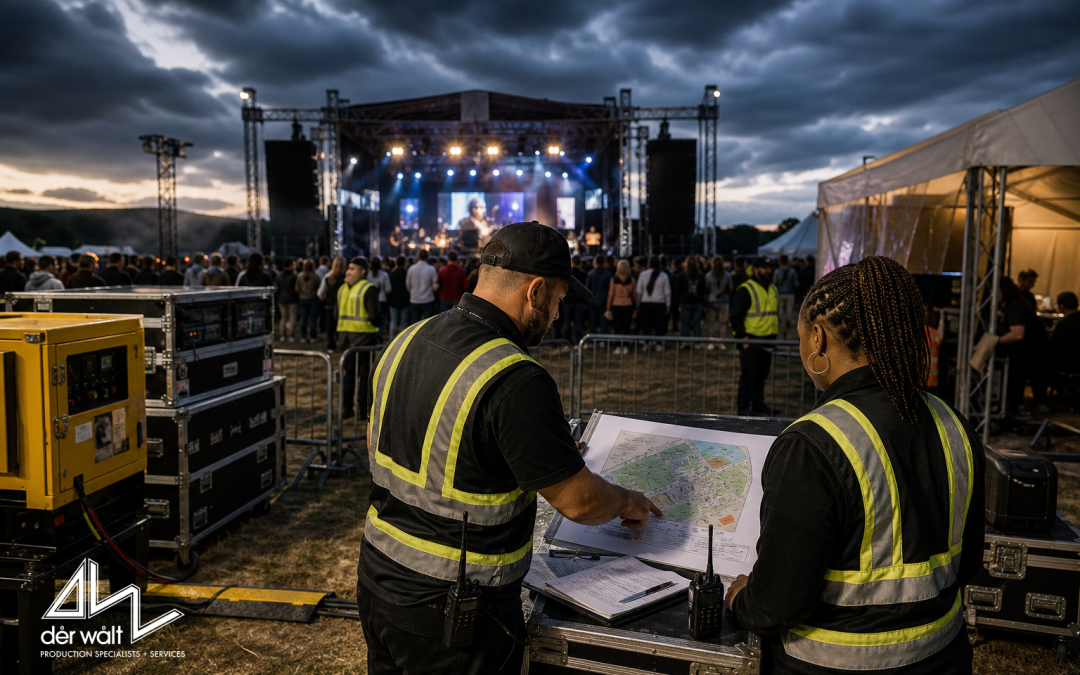
- Scope the event and map the site: Obtain site drawings, access points, and nearby services. Create a floorplan showing stages, barriers, emergency routes, first aid posts, and control zones.
- Identify hazards: Weather, collapse or failure of temporary structures, electrical hazards, slips and trips, fire risks, crowd surges, medical incidents, security threats, and environmental factors.
- Assess risk using a simple matrix: Likelihood (Rare, Possible, Likely, Almost Certain) vs. Consequence (Minor, Moderate, Major, Catastrophic). Prioritise high-risk items for immediate controls.
- Implement controls (the hierarchy of controls): Eliminate hazards where possible, substitute with safer options, isolate hazards, apply engineering controls, implement administrative controls (policies, checklists), and ensure PPE where appropriate.
- Plan emergency response and evacuation: Define muster points, communication channels, roles for safety officers, medical responders, and security, plus tested evacuation routes vetted by authorities.
- Assign roles and responsibilities: Safety officer, event controller, crowd managers, electrical supervisor, medical lead, security coordinator, and logistics lead. Ensure clear handover points and shift changes.
- Document and sign off: Produce a site safety plan, risk register, permit checklists, and a run-of-show with safety milestones. Secure approvals from the relevant authorities and the client.
- Review and rehearse: Schedule a pre-event walk-through and a simulated drill to test communication, evacuation, and medical response plans.
What should a site safety plan cover?
- Site layout and barriers, with sightlines and accessibility considerations.
- Electrical, generator, and lighting plans, including fuel and refill procedures.
- Crowd management zones, ingress/egress routes, and staff positioning.
- Medical services, first aid posts, and ambulance access points.
- Fire safety: extinguishers, fire marshal roles, and evacuation routes.
- Weather contingency strategies and communications protocols.
- Environmental controls: waste, recycling, and noise management.
- Regulatory permits and stakeholder communications.
Production management and logistics: translating risk into action
Production management translates risk assessment into a live, working plan. It integrates venue logistics, supplier coordination, and regulatory compliance into a single delivery timeline. In South Africa, this also means engaging with local suppliers and confirming permits well in advance to accommodate procurement timelines and potential municipal approvals.
Site layout and logistics
Create a detailed floorplan showing stage locations, power points, water points, sanitation facilities, and medical posts. Mark access routes for vehicles, crew, and emergency responders. Ensure redundancy for critical nodes like power, communications, and medical support.
Power and technical planning
Develop a power plan that accounts for AV loads, lighting, and climate control. Specify generator specifications, fuel supply, fueling stations, and noise mitigation strategies. In SA, plan around load shedding timelines and ensure onsite backup power with adequate fuel reserves and safe storage.
Procurement and supplier coordination
Work with local SA suppliers when possible to reduce lead times. Build a supplier risk register that tracks lead times, service levels, insurance, and compliance. Schedule regular coordination meetings in the weeks leading to the event.
Traffic, transport and access
Coordinate with the local municipality and traffic authorities to plan road closures, drop-off zones, and parking. Provide clear signage, shuttle options, and crowd flow instructions to minimize vehicle-pedestrian conflicts.
Safety, crowd management and sustainability
Safety and sustainability intersect at every decision. A robust crowd management plan reduces risk and improves attendee experience while sustainability considerations reduce environmental impact and long-term costs. Build in environmental best practices from the start—waste minimisation, recycling, and efficient energy use.
Crowd safety and access
Define steward positions, training, and briefing protocols. Use clearly marked entrances, ringed barriers where needed, and unobstructed sightlines to stages and exits. Ensure women, children, and vulnerable groups have clearly identifiable assistance points.
Medical readiness and emergency response
Staff trained in basic life support, with a dedicated medical post and rapid access to ambulance deployment. Maintain a medical communication loop with on-site teams and external EMS services. Pre-plan for peak loads and weather-related medical needs such as heat illness or dehydration.
Fire safety and cooling measures
Place fire suppression equipment where risk is highest and appoint trained marshals. Ensure clear evacuation routes and muster points, with ongoing public address announcements during incidents or weather events.
Sustainability and waste management
Implement a waste plan that emphasizes separation, recycling, and responsible disposal. Consider reusable or recyclable materials for temporary installations and optimize energy use in stages and lighting to reduce emissions and cost.
Budgeting and timeline considerations
Align safety investments with the event’s scale and risk profile. Include contingency allocations for unexpected permits, weather events, and supplier delays. Build a realistic production schedule that reserves time for permit approvals, site prep, rehearsals, and contingency days.
Key budgeting tips
- Separate a safety contingency fund (often 5–15% of total budget, depending on risk level).
- account for generator fuel, water, medical services, security, and insurance.
- Plan for permit fees, safety equipment, and staff accommodations or transport if required.
Common mistakes and local considerations
- Underestimating permit lead times and municipal approvals—start early and document all required permissions.
- Ignoring power reliability—avoid single points of failure; lock in backup power and fuel plans.
- Failing to rehearse emergency scenarios—practice drills and clear communications are essential.
- Inadequate crowd management planning for large gatherings—design flows that minimise bottlenecks and confusion.
- Overlooking accessibility and inclusivity—ensure safe, easy access and assistance for all attendees.
Frequently asked questions
What is a site-specific risk assessment?
A site-specific risk assessment identifies hazards at a particular venue, evaluates the likelihood and impact of each hazard, and specifies controls and responsibilities tailored to that site.
How do you handle weather and load shedding in SA events?
Develop a weather monitoring protocol, have shelter and contingency plans, and ensure a robust power backup strategy with fuel and maintenance planning to minimise downtime.
What permits are typically required for large events in South Africa?
Permit needs vary by municipality but commonly include venue-use permits, road closure approvals, noise permits, and safety certificates. Engage early with the local council to confirm requirements.
How should I coordinate with suppliers and security?
Set up regular coordination meetings, establish clear service level expectations, capture responsibility charts, and verify insurance and health and safety compliance for all contractors.
How can I measure safety performance after the event?
Review incident logs, conduct debriefs with safety and operations teams, quantify near-misses, and compare against the risk register to identify lessons learned for future events.
Sources
- ISO 20121: Sustainable events management — International Organization for Standardization
- Event safety guidance — UK Health and Safety Executive
- NFPA 101 Life Safety Code overview — National Fire Protection Association
Ready to elevate your next activation?
If you’re planning a large-scale experiential activation, talk to DERWALT about end-to-end event delivery—from risk assessment and safety planning to production management, logistics, and on-site execution. We specialise in turning complex briefs into smooth, standout live experiences.
Recent Comments