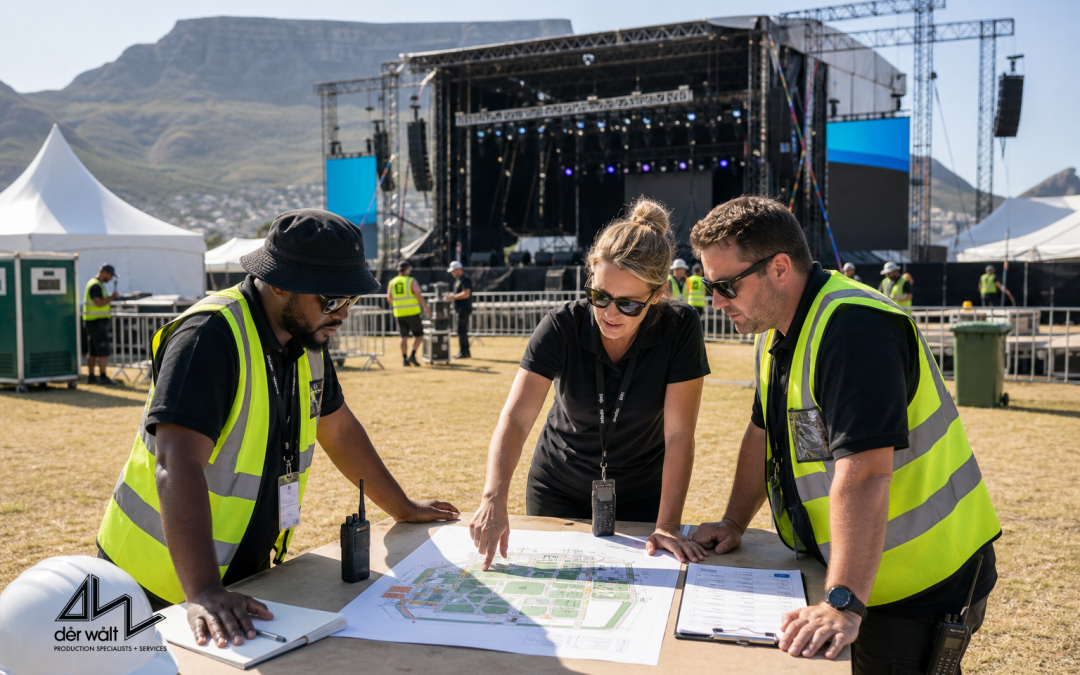
Practical risk assessment and safety planning for South African events
A practical, action-ready guide to risk assessment and safety planning for large-scale South African events, covering hazard identification, risk registers, crowd safety, weather contingency, and emergency response.
Direct answer: A practical risk assessment for a large South African event begins with a formal, documented hazard-identification process, a risk matrix, and a live risk register integrated into the production plan and rehearsals. Primary search intent: How to implement practical risk assessment and safety planning for large-scale SA events.
Context and importance
Events of any scale in South Africa demand deliberate safety planning that aligns with local regulatory expectations, weather realities, and logistical constraints. South Africa’s climate can vary drastically across regions and seasons, from heat and glare to heavy rains and windy conditions. Power reliability (including load shedding) can affect lighting, sound, and refrigeration, influencing decision-making around contingency power and equipment protection. Transport and crowd movement require clear egress routes, robust access control, and coordination with local authorities and emergency services. All of these factors shape the risk landscape for activations, festivals, conferences, and brand experiences.
A well-structured risk process not only helps protect people and assets but also supports smoother operations, faster incident response, and more predictable schedules. When risk management is embedded into the planning culture, teams can anticipate disruptions, communicate clearly with partners, and maintain brand integrity even under pressure.
Practical guidance: 建 step-by-step risk assessment workflow
Step 1 — Define scope, governance, and roles
Identify the event’s boundaries, timelines, and critical decision-makers. Appoint a risk lead and assign owners for safety, operations, medical, security, electrical, and logistics. Establish a shared, version-controlled risk register that all core teams can access.
Step 2 — Hazard identification and brainstorming
Conduct structured workshops with production, security, medical, venue staff, and partner agencies to identify hazards across stages of the event: pre-event build, load-in, setup, run-of-show, and load-out. Consider hazards related to electricity, rigging, crowd flow, weather, fire, medical incidents, communications, and supplier failure.
Step 3 — Risk scoring and prioritisation
Use a simple likelihood × consequence matrix to rate each hazard (for example, 1–5 for both axes). Prioritise actions where risk is medium to high and ensure immediate attention for life-safety hazards. Keep the methodology transparent so all teams understand why certain mitigations are prioritized.
Step 4 — Build and maintain a live risk register
The risk register should include: Hazard, Likelihood, Impact, Risk Rating, Mitigations, Owner, Due Date, and Status. Update it after planning milestones, site walks, rehearsals, and incident reviews. A live register enables rapid decision-making on site and during events.
Step 5 — Mitigations: design, procedures, and training
Mitigations can be physical, procedural, or functional. Examples include: selecting wind-stable stage configurations, implementing redundant power feeds and protective enclosures, designing crowd routes with clear egress and accessibility, establishing medical stations with trained responders, and pre-briefing staff on emergency signals and communication protocols. Train teams on Safe Work Method Statements (SWMS) and RAMS (risk assessments and method statements), ensuring all activities have documented safety steps.
Step 6 — Weather readiness and contingency planning
Develop weather thresholds for pausing activities, delaying or evacuating areas, and protecting equipment. In SA, rapid weather shifts can affect outdoor experiences; have sheltered spaces, portable shading, misting or cooling options, and storm-response procedures ready. Predefine power management plans to handle heat or outages during peak show moments.
Step 7 — Crowd safety and venue logistics
Map audience flows, entry points, queues, and egress routes. Validate capacity limits with the venue and local authorities. Implement clear wayfinding, staff-trained stewards, and communication devices to coordinate during surges or incidents. Ensure medical, fire, and security teams have direct access to control points and on-site contingency plans.
Step 8 — Permits, compliance, and local coordination
Identify required permits, safety standards, and liaison points with municipal authorities, venue management, and emergency services. Create a contact tree and a dedicated liaison role for regulatory compliance during planning and execution.
Step 9 — Documentation, audits, and rehearsal
Document all plans, including RAMS/SWMS, emergency procedures, and communications protocols. Conduct site walks and a full-scale drill to validate safety readiness. Use debriefs after rehearsals to adjust mitigations before the live event.
Step 10 — Post-event learning and continuous improvement
Review what worked and what didn’t, update the risk register, and share lessons with stakeholders to improve future activations. Maintain an archive of risk assessments for reference in permit renewals and future builds.
Checklist: pre-event risk readiness
- Formal risk register with assigned owners and due dates
- RAMS/SWMS for high-risk activities (rigging, electrical, elevated platforms)
- Weather contingency plans and protective measures for equipment
- Crowd management plan with entry/egress modeling
- Emergency response plan, muster points, and communication protocol
- Permits, venue approvals, and liaison contacts
- Staff training, briefings, and drills completed
- On-site safety equipment, first aid, and medical response readiness
Common mistakes and key considerations
- Underestimating weather-related risks or over-relying on outdoor spaces without shelter plans.
- Treating risk assessment as a one-off task instead of an ongoing process tied to the production schedule.
- Omitting supplier dependencies and transport disruptions from risk thinking.
- Failing to update the risk register after rehearsals or site inspections.
- Neglecting communications: unclear signals can delay response during incidents.
FAQ
What is a risk assessment for events?
A risk assessment systematically identifies hazards, evaluates their risk, and defines mitigations to reduce the likelihood and impact of harm to people and assets.
How often should the risk register be updated?
Update it at major planning milestones, after site visits or rehearsals, and whenever new hazards emerge or mitigations change.
Who should be involved in the risk assessment?
Include production, safety, security, medical, venue staff, transportation, volunteers, and a designated risk lead, plus any relevant regulatory or emergency-services liaisons.
What are typical weather-related mitigations for SA outdoor events?
Prepare shaded areas, cooling options, rain shelters, wind-stable setups for stages, and a clear protocol to pause or evacuate when thresholds are exceeded.
How do we test safety plans before the event?
Run site walks, table-top drills, and a full-scale rehearsal to validate procedures, communications, and response times; capture lessons and adjust accordingly.
What permits and compliance should we consider in South Africa?
Check with the venue and local municipality for required permits, fire and safety codes, crowd-management requirements, and any environmental or traffic considerations relevant to the location.
Sources
- Event safety – Health and Safety Executive (HSE) — UK Health and Safety Executive
- Mass gatherings and public health emergencies – World Health Organization — WHO
- South African Weather Service — SAWS
- Event Safety Alliance — Industry safety guidance
- International Association of Venue Managers — IAVM
Ready to bring safer, smoother experiences to life?
Contact DERWALT for end-to-end experiential marketing, activation and event-production support that prioritises safety, efficiency and impact.
Recent Comments