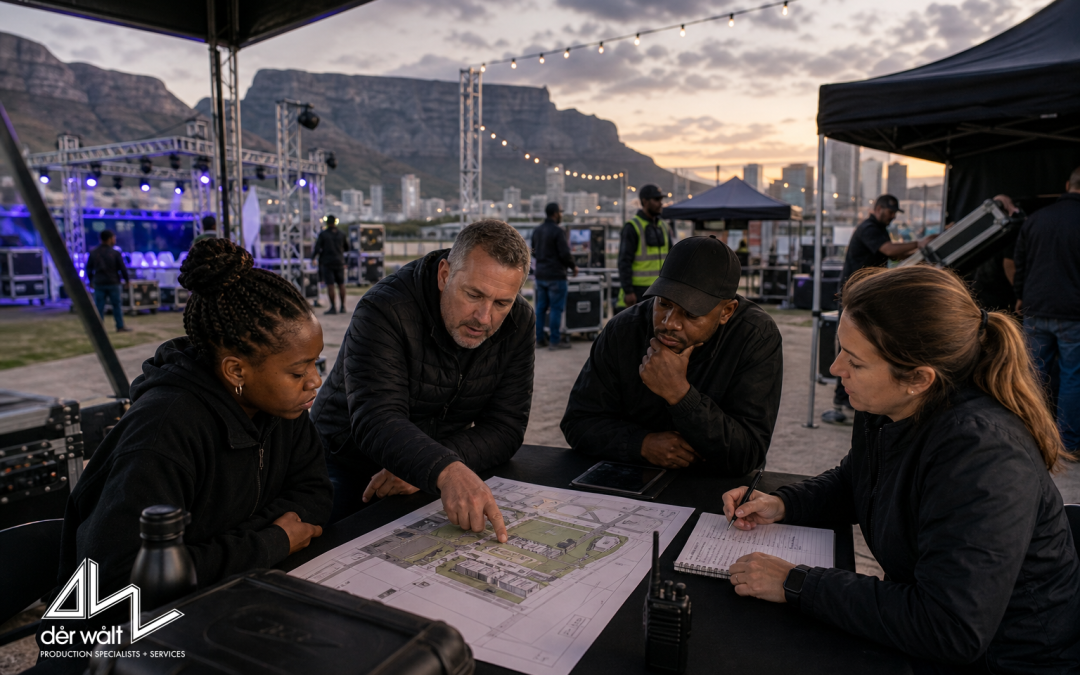
Practical production planning for successful South African experiential campaigns
A practical guide for brands, agencies and venues delivering experiential marketing in South Africa. Learn how to align procurement, safety, weather planning, transport and budgets to keep projects on time and within scope.
Experiential campaigns in South Africa demand more than creative concepting and on-brand activations. They require deliberate production planning that aligns creative ambitions with local realities — procurement cycles, available suppliers, transport constraints, weather patterns and labour norms. The goal is to reduce risk, stay on schedule and deliver a cohesive brand moment across multiple sites if needed. This article outlines a practical approach to end-to-end production management that blends industry best practice with South African context, so brands, agencies, venues and production teams can move from concept to on-site delivery with confidence. It also highlights how DERWALT’s capabilities in production management, logistics, supplier coordination and activation support can help teams execute complex campaigns while staying within budget and timeline expectations.
Integrated planning: from concept to on-site execution
Successful experiential campaigns start with an integrated plan that translates the creative brief into actionable production steps. In South Africa, this means pairing your creative concept with a realistic site and supplier map early in the process. Build a living production calendar that ties milestones to procurement lead times, permitting windows and weather contingencies. This approach helps prevent last-minute bottlenecks and enables parallel work streams, such as content creation while venue permits are secured or power and staging equipment are sourced.
Budgeting and procurement in South Africa
Budgeting for SA campaigns should reflect local realities: lead times for equipment and services, labour rates that align with sector standards, and transport costs impacted by road networks and geography. Establish a procurement strategy that prioritises local suppliers where possible to shorten lead times and support transformation objectives. Document a clear approval workflow for vendor selection, and include contingency allowances for weather- or transport-related delays. Use industry guidelines to shape your risk reserves and to justify cost baselines to stakeholders. The goal is transparency and predictability rather than “guesswork.”
Sourcing and procurement: local suppliers and supplier matrix
Develop a supplier matrix early in the project. List potential rentals, staging, power, AV, fabrication, transport and on-site services with lead times, minimum orders, payment terms and safety credentials. Prioritise reputable, locally available partners and request written safety and compliance statements. When possible, run a pre-event site walk with key suppliers to agree on access routes, load-in/load-out windows, storage, and contingency spaces. This reduces surprises on site and accelerates setup on show day. Remember to document all procurement decisions and attach them to your master project plan for auditability and accountability.
Safety, compliance and risk management
Any on-site activation carries risk. In SA, the risk profile is shaped by crowd dynamics, weather, and the complexity of multi-site logistics. A formal safety framework anchored in recognized standards helps teams identify, assess and mitigate risks before they impact delivery. This is where ISO-aligned thinking meets local practice: map hazards, define control measures, assign ownership, and validate via a simple risk assessment process that all team members understand. The objective is not just compliance, but a safer, more efficient production environment that protects staff, performers, audiences and assets.
Safety planning and on-site risk management
Develop a safety plan rooted in principle rather than paperwork. Start with site-specific risk assessments that consider crowd movement, access control, temporary structures and electrical safety. Confirm responsible persons for safety oversight during setup, show, and breakdown, and ensure a continuous line of communication with venue management and local authorities where required. Build in time buffers for safety checks after weather events or power interruptions, and rehearse your emergency response procedures with the on-site team so everyone knows their role when the moment demands it.
Practical safety practices: crowd management and temporary structures
When working with crowds and temporary structures, the practical guidance matters as much as formal requirements. Use robust ingress/egress planning, clearly marked pathways and barrier systems appropriate to venue type and expected audience size. For temporary structures, select equipment certified to relevant safety standards and schedule on-site inspections during installation. Establish a portable power plan with redundancy, including safe distances between power sources and high-traffic areas. These steps help avoid avoidable incidents and ensure smooth guest experiences.
Weather, transport and site logistics
Weather is often unpredictable in many parts of South Africa, from coastal winds to inland heat. Transport networks can be uneven, and last-mile delivery may depend on remote venues or makeshift activation spaces. Planning for these realities reduces the risk of weather-driven disruptions and keeps timelines intact. A well-considered logistics strategy also improves on-site efficiency, from set-up to tear-down, by clarifying roles, access routes and vehicle clearance requirements.
Venue considerations in South Africa
Choose venues with a clear understanding of load-in/load-out constraints, power capacity, Wi-Fi reliability, and accessibility for crew and equipment. Outdoor venues require additional sensibilities around weather, sun exposure and shade; indoor venues need careful coordination with house sound and rigging standards. In both cases, engage venue management early to confirm venue-specific rules, insurance requirements and any restrictions on amplified sound or late-hour activity. A documented plan for back-of-house logistics, storage, and waste management helps prevent day-of conflicts and keeps the activation running smoothly.
Transport and labour logistics
Transport planning should account for distance, fuel costs, and traffic patterns in major South African cities. Build a dedicated transport schedule that maps crew travel times, equipment deliveries, and contingency routes. Labour logistics should align with applicable employment laws and industry best practices, including fair shifts, breaks, and safety training. Consolidating shifts, providing on-site meals, and ensuring safe accommodations for crews working away from home can all impact morale and performance, ultimately influencing on-site execution.
Sustainability and compliance in practice
Many brands now expect activations to demonstrate environmental stewardship and responsible procurement. ISO 20121 provides a framework for sustainable event management, covering stakeholder engagement, resource use, waste reduction, and supply chain transparency. In practice, this means planning for recycling and waste segregation on site, minimizing single-use materials, and choosing energy-efficient solutions where possible. It also means communicating sustainability goals to your partners and venue teams so everyone understands how success is measured beyond attendee numbers.
Waste management and energy use
Put in place a practical waste plan that includes separation at source, clear labeling and partner disposal options. For energy, consider renewable options like portable solar or hybrid power solutions where they align with safety and reliability requirements. Document energy usage targets and track consumption across the activation; this creates a narrative for sponsors and helps with future planning. Remember that some venues may have their own sustainability policies; align your plan with those expectations to avoid conflicts on site.
Embedding ISO 20121 in your next activation
Adopting an ISO 20121 approach does not require a full certification project for every activation. Use its core principles to guide decision-making: define stakeholder needs, map risks, set measurable objectives, and review performance after the event. This structured approach improves accountability, resilience and long-term value from your experiential marketing investments. It also aligns with South Africa’s emphasis on responsible procurement and transformation, which many brands view as a strategic differentiator.
Practical checklists and timelines
To move from concept to curtain call with predictability, use a practical, phased checklist. A typical runway may include the following at a high level, with exact dates tailored to your project:
- Concept-to-production brief alignment and stakeholder sign-off
- Supplier sourcing, risk assessment and safety plan draft
- Venue confirmation, permits where required, and load-in/load-out planning
- Technical rehearsal windows, content delivery schedules, and on-site logistics
- Weather contingency planning and backup activation routes
- On-site safety briefings, crew inductions and emergency procedures
- Waste and energy management plan execution during the activation
- Post-event debrief, performance review and learnings capture
Each activation will have its own constraints and priorities. The approach above aims to provide practical steps that teams can adapt to their specific context. It’s about reducing complexity, improving reliability, and delivering a coherent brand experience across locations and over time. If you’re balancing multiple sites, tight timelines or ambitious creative ambitions, framing production as a single, coordinated system helps align creative with operational realities.
Sources
- Occupational Health and Safety Act, 1993 (Act No. 85 of 1993) — Department of Employment and Labour
- ISO 20121:2012 Sustainable event management — International Organization for Standardization
- Event safety and risk assessment guidelines — Health and Safety Executive (UK)
- South African Weather Service — Weather guidance for events
Ready to elevate your next activation?
DERWALT offers end-to-end production management, logistics coordination, supplier liaison, content support and on-site activation delivery. If you’re planning a South African experiential campaign, talk to us about how we can help you navigate procurement, safety, weather planning, transport and timelines to deliver a seamless, memorable experience.
Recent Comments