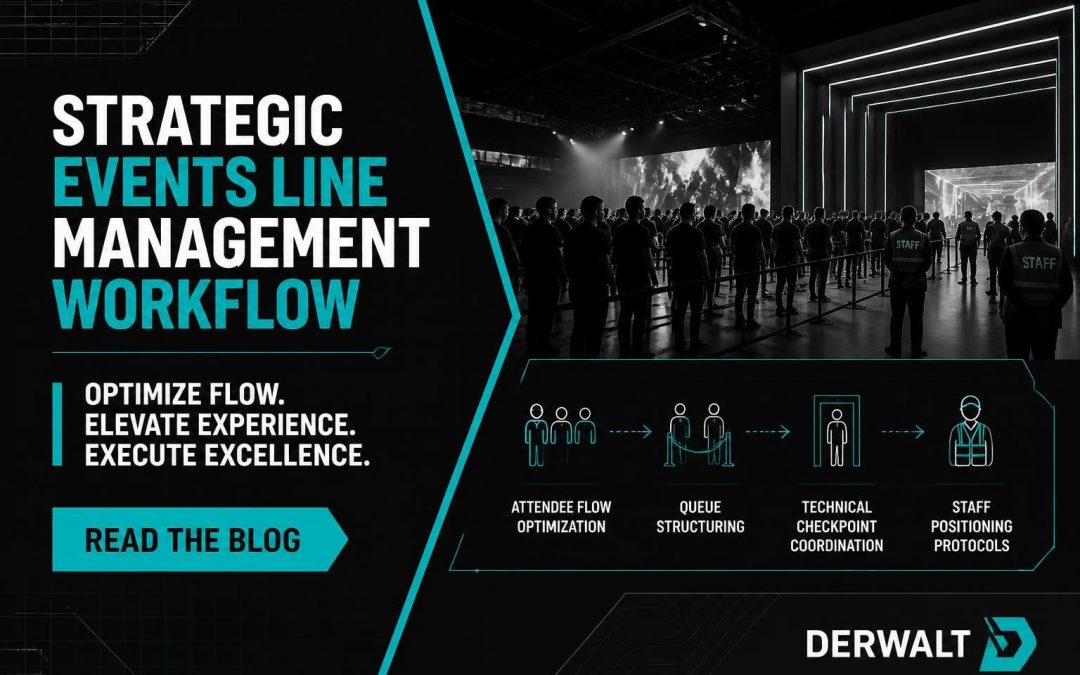
Events line management represents one of the most critical yet frequently underestimated components of successful event production. The ability to orchestrate seamless attendee flow, minimize wait times, and maintain brand experience quality throughout every touchpoint directly impacts event ROI and brand perception. In 2026, as live experiences continue to evolve with heightened attendee expectations and technical complexity, the strategic approach to events line operations has become a fundamental production discipline rather than an operational afterthought.
Strategic Framework for Events Line Architecture
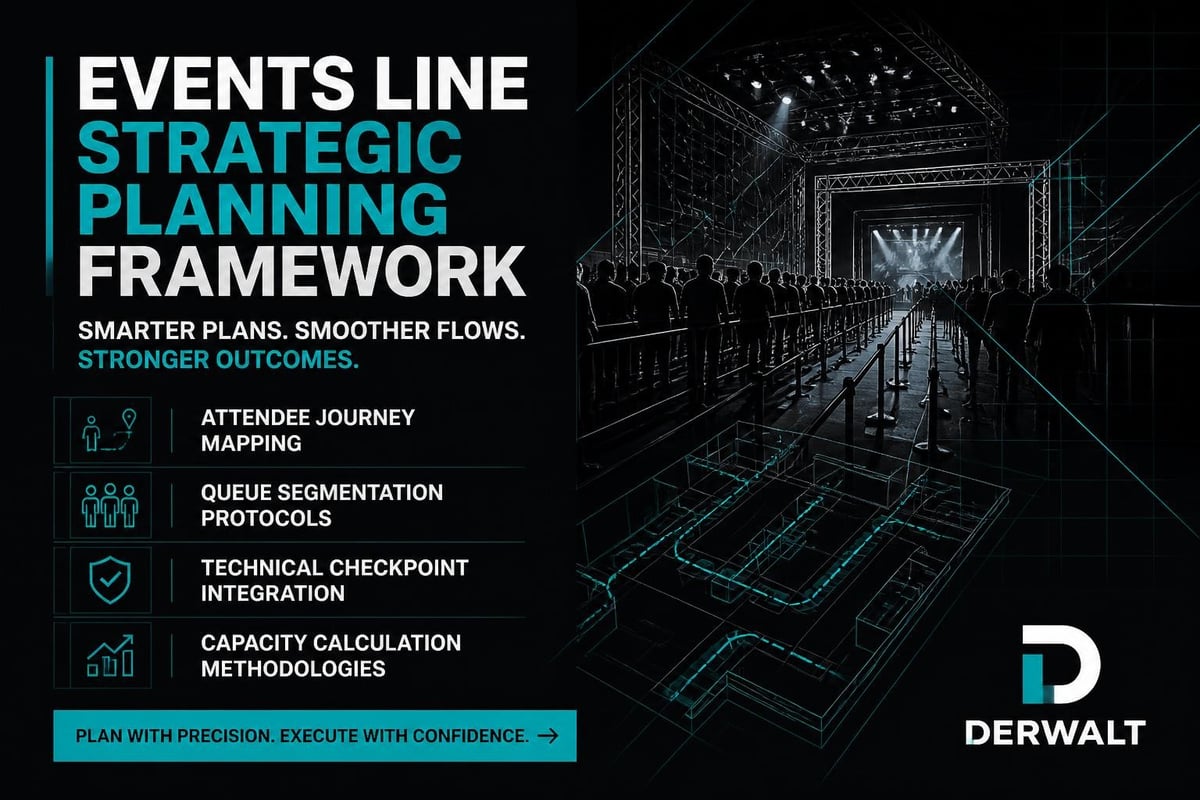
Effective events line management begins with production intelligence, not operational improvisation. The foundation requires comprehensive spatial analysis, attendee behavior modeling, and technical infrastructure planning executed during pre-production phases.
Strategic line architecture considers multiple variables simultaneously: venue topology, expected attendance volumes, registration technology integration, security protocols, accessibility requirements, and brand experience continuity. Each variable influences queue configuration, staffing calculations, and technical deployment strategies.
Pre-Production Planning Parameters
Production teams must establish baseline metrics before designing events line structures. Calculate expected throughput rates based on historical data, registration technology specifications, and security screening requirements. Industry benchmarks suggest 250-300 attendees per hour per registration station under optimal conditions, but real-world performance varies significantly.
Critical planning inputs include:
- Peak arrival time projections and distribution curves
- Registration technology processing speeds and failure protocols
- Physical space constraints and accessibility compliance requirements
- Security screening duration and staffing capacity
- Credential production methods and printing speeds
Spatial planning must account for queue density management, with recommended allocations of 0.8-1.2 square meters per person in standing queues. Underestimating space requirements creates safety hazards, brand experience degradation, and operational bottlenecks that cascade throughout event timelines.
Technical Infrastructure and Queue Technology Integration
The events line becomes a technical environment requiring comprehensive infrastructure planning. Registration systems, credential printing, network connectivity, power distribution, and backup protocols form an integrated ecosystem that determines operational success or failure.
Network architecture represents the critical technical foundation. Primary and redundant connectivity solutions must support simultaneous registration transactions, real-time database synchronization, and credential production without latency. Plan for 10-15 Mbps dedicated bandwidth per registration station cluster, with automatic failover to cellular backup systems.
| Technical Component | Primary Specification | Redundancy Protocol |
|---|---|---|
| Network Connectivity | Dedicated fiber/wireless | 4G/5G cellular backup |
| Power Distribution | Isolated circuits per zone | UPS systems + generators |
| Registration Devices | Commercial-grade tablets | Hot-swap device pool |
| Credential Printers | High-speed thermal units | Backup units at 25% ratio |
| Database Systems | Cloud-based real-time sync | Local cache capability |
Registration Technology Deployment Strategy
Technology selection and deployment methodology directly impact events line performance. Cloud-based registration platforms with offline functionality provide operational resilience during network disruptions. However, systems must undergo comprehensive load testing under simulated peak conditions before deployment.
Device positioning requires ergonomic consideration for staff efficiency and attendee interaction quality. Best practices for event check-in processes emphasize designing efficient flows that maintain brand experience standards while maximizing throughput. Counter heights, screen visibility, cable management, and staff movement patterns all influence operational performance.
Credential production methodology selection involves strategic trade-offs between pre-printed materials, on-demand printing, and hybrid approaches. Pre-printed credentials eliminate technical dependencies but reduce flexibility for last-minute changes. On-demand systems provide maximum adaptability but introduce technical failure points that require comprehensive contingency planning.
Staffing Architecture and Line Captain Protocols
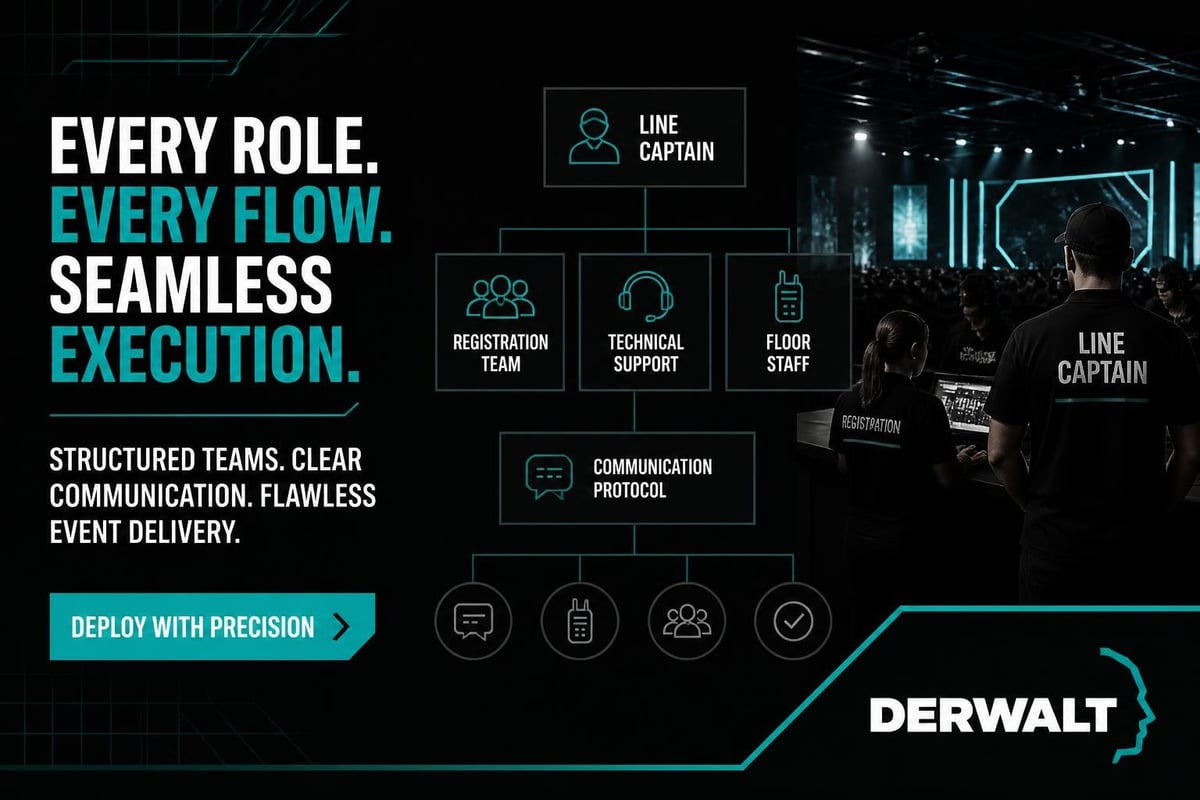
Events line operations require specialized staffing structures with clearly defined roles, decision-making authority, and communication protocols. Event line captains play a critical role in managing high-volume queues by maintaining queue integrity, directing attendee flow, and preventing operational failures before they impact brand experience.
Staffing calculations must account for multiple operational layers beyond simple registration transactions. Queue management personnel, technical support specialists, accessibility coordinators, and supervisory leadership form integrated teams that maintain operational continuity throughout arrival windows.
Role Definition and Authority Structures
Line captains require clear authority boundaries and decision-making frameworks. They must coordinate with registration staff, security teams, technical support, and production management while maintaining real-time operational awareness across the entire events line ecosystem.
Line captain responsibilities include:
- Queue density monitoring and overflow protocol activation
- Staffing allocation adjustments based on real-time throughput
- Technical issue escalation and workaround implementation
- Attendee communication regarding wait times and expectations
- Incident documentation and production management coordination
Effective staffing ratios depend on expected volumes and technical complexity. Professional staffing guidelines recommend one registration staff member per 30-40 attendees during peak periods, with additional queue management personnel at ratios of 1:100 for crowd guidance and experience maintenance.
Queue Psychology and Experience Design
Events line management extends beyond operational logistics into experiential design territory. The queue represents a critical brand touchpoint where attendee perception forms before primary event experiences begin. Strategic production teams recognize that storytelling strategies should extend into queue environments, transforming wait times into engagement opportunities.
Psychological factors significantly influence perceived wait times versus actual duration. Research consistently demonstrates that engaged, informed attendees perceive wait times as 20-30% shorter than disengaged counterparts experiencing identical durations. This perception gap creates strategic opportunities for production teams focused on brand experience optimization.
Engagement Strategy Implementation
Queue activation transforms passive waiting into active brand engagement through strategic content deployment, interactive elements, and information architecture. Digital displays showing event schedules, speaker information, or brand storytelling content maintain engagement while setting experience expectations.
Physical queue design influences psychological perception through environmental factors. Serpentine queue configurations, despite creating longer physical paths, typically generate more positive attendee sentiment than linear queues of equivalent wait duration. The perception of movement and progress reduces frustration even when actual wait times remain constant.
Audio environments require careful consideration. Background music, branded soundscapes, or ambient content can enhance brand experience, but volume levels must allow staff-attendee communication without requiring voice elevation that signals operational stress.
Risk Mitigation and Contingency Protocols
Events line operations concentrate multiple failure points within compressed timeframes, making comprehensive risk mitigation essential for production intelligence. Technical failures, staffing shortages, weather disruptions, and security incidents can cascade rapidly without predetermined response protocols.
Event production best practices emphasize the importance of thorough contingency planning across all operational domains. Events line environments require specific scenario planning for technology failures, extreme weather conditions, accessibility challenges, and security escalations.
Critical contingency protocols include:
| Risk Category | Mitigation Strategy | Activation Trigger |
|---|---|---|
| Network Failure | Offline registration mode | 30-second connectivity loss |
| Power Outage | UPS + generator deployment | Immediate automatic switchover |
| Severe Weather | Indoor queue migration | Weather alert threshold |
| Equipment Failure | Hot-swap device replacement | Single-transaction failure |
| Staffing Shortage | Cross-trained backup deployment | 15-minute delayed arrival |
Real-Time Operational Adjustment Frameworks
Production management must maintain real-time visibility into events line performance metrics to enable dynamic operational adjustments. Dashboard systems tracking throughput rates, queue lengths, wait times, and technical system performance provide decision-making intelligence for resource reallocation.
Communication protocols between line captains and production management require predetermined escalation criteria and response timeframes. When wait times exceed acceptable thresholds or technical issues emerge, clear decision authority prevents operational paralysis during critical moments.
DERWALT approaches production challenges through integrated systems thinking rather than isolated tactical responses. Production intelligence for brand experiences encompasses strategic planning, technical delivery, risk mitigation, and on-site execution as interconnected disciplines that determine event success.
Integration with Broader Event Production Ecosystems
Events line operations cannot function as isolated components within larger production frameworks. Integration with security protocols, session scheduling, venue logistics, and technical infrastructure requires comprehensive coordination across multiple operational domains.
Security integration represents a particularly critical coordination point. Access control systems, credential validation technology, and physical screening protocols must align seamlessly with registration workflows to prevent bottlenecks at secondary checkpoints that negate upstream efficiency gains.
Cross-Functional Coordination Requirements
Comprehensive production management requires synchronized planning across creative, technical, and operational teams. Events line design must reflect overall brand experience strategy while accommodating technical requirements and operational realities.
Session scheduling influences arrival patterns and queue management strategies. When keynote presentations or high-demand sessions create concentrated arrival windows, events line capacity must scale accordingly. Staggered entry protocols, priority queuing systems, or pre-event communication strategies can distribute arrival patterns more evenly across available timeframes.
Venue coordination extends beyond physical space allocation. Loading dock access, power infrastructure, network connectivity points, and environmental control systems all influence events line deployment strategies. Technical planning services must account for these interdependencies during pre-production phases.
Data Collection and Performance Optimization
Events line environments generate valuable operational data that informs both real-time adjustments and long-term production optimization. Throughput metrics, wait time tracking, technology performance data, and attendee feedback create intelligence foundations for continuous improvement.
Registration systems capture transaction timestamps, processing durations, and error frequencies that reveal operational patterns and improvement opportunities. Queue management systems with sensor technology or manual logging protocols document arrival distributions, peak capacity utilization, and bottleneck identification.
Post-Event Analysis and Knowledge Transfer
Post-event learning represents a critical component of production intelligence methodology. Systematic data analysis, staff debriefings, and documented lessons learned transform individual event experiences into organizational knowledge that enhances future production planning.
Performance metrics should be benchmarked against planning assumptions to validate or adjust forecasting models. When actual throughput rates, arrival distributions, or technology performance deviate significantly from projections, root cause analysis determines whether planning assumptions, implementation execution, or external factors drove the variance.
Documentation protocols must capture both quantitative metrics and qualitative observations. Technical system performance logs, staffing allocation records, and timeline documentation provide objective data, while staff feedback and attendee sentiment offer contextual insights that purely numerical analysis cannot reveal.
Accessibility and Inclusive Design Principles
Events line design must accommodate diverse attendee populations with varying accessibility requirements. Regulatory compliance represents the minimum standard, while inclusive design principles create superior brand experiences for all participants.
Physical queue configurations require wheelchair accessibility, clear sight lines for wayfinding, and accommodation for mobility devices. Dedicated accessibility registration stations reduce wait times for attendees requiring additional assistance while maintaining dignity and brand experience quality.
Communication accessibility extends beyond physical design. Visual wayfinding systems, multilingual staff capabilities, and alternative format materials ensure that language barriers or sensory limitations do not create exclusionary experiences. Experiential event marketing excellence requires inclusive approaches that serve entire attendee populations effectively.
Technology Accessibility Considerations
Registration technology must support accessibility features including adjustable display settings, alternative input methods, and compatibility with assistive devices. Staff training on accessibility protocols ensures that technical accommodations function effectively when required.
Queue management strategies should anticipate accessibility-related timing variations. Attendees requiring additional assistance may require extended processing times, and staffing allocations must account for these requirements without creating operational bottlenecks or compromising experience quality.
Budget Optimization and Resource Allocation
Events line operations represent significant budget allocations across technology, staffing, infrastructure, and contingency resources. Strategic production planning balances experience quality requirements against budget constraints through systematic resource optimization.
Technology investment decisions involve total cost of ownership analysis rather than simple acquisition pricing. Registration platform licensing, hardware procurement, network connectivity, technical support, and maintenance costs accumulate across the complete event lifecycle.
Budget allocation framework:
- Registration technology and devices: 25-30% of events line budget
- Staffing costs (including training): 40-45% of events line budget
- Infrastructure (power, network, physical setup): 15-20% of events line budget
- Contingency reserves and backup systems: 10-15% of events line budget
Staffing represents the largest individual cost component but also the most critical operational variable. Understaffing creates cascading failures that damage brand experience and event timelines. Overstaffing wastes budget resources without proportional experience enhancement. Comprehensive event production checklists help production teams calculate optimal staffing levels based on expected volumes and operational complexity.
Infrastructure investments in power distribution, network connectivity, and physical setup vary significantly based on venue capabilities. Venues with robust technical infrastructure reduce deployment costs, while venues requiring comprehensive infrastructure buildouts increase budget requirements substantially.
Hybrid and Virtual Event Considerations
While physical events line management focuses on spatial and operational logistics, hybrid event formats introduce parallel virtual queue management requirements. Virtual attendees experience different but equally important registration and access workflows that require strategic planning and technical infrastructure.
Virtual registration systems must accommodate concurrent user loads during peak access periods. Server capacity planning, content delivery network deployment, and authentication system scaling prevent technical failures when thousands of virtual attendees attempt simultaneous platform access.
Best practices for virtual event production emphasize advance testing under simulated load conditions to identify capacity constraints before live deployment. Hybrid events compound complexity by requiring parallel operational streams for physical and virtual attendees with synchronized timing and coordinated brand experiences.
Communication protocols for virtual queues differ substantially from physical environments. Digital communications through email, platform notifications, and status displays replace physical signage and verbal staff guidance. However, the fundamental principle remains consistent: informed attendees experience lower frustration and higher satisfaction regardless of attendance format.
Strategic events line management separates exceptional brand activations from operational failures that undermine months of creative and strategic planning. The integration of production intelligence, technical infrastructure, staffing protocols, and experience design creates seamless attendee journeys that strengthen brand perception from first contact. When your next activation requires flawless execution across every production discipline, DERWALT delivers the integrated systems, technical expertise, and operational excellence that transform creative concepts into measurable business outcomes.
Recent Comments