The foundation of every successful brand experience begins long before venue selection or supplier contracts. It starts with a disciplined, strategic approach to developing a concept for event execution that aligns business objectives with creative expression and operational reality. In the South African event production landscape, where budget constraints meet ambitious brand expectations, the difference between a memorable activation and a costly misstep lies in the rigor applied during conceptualization.
A well-constructed concept for event delivery serves as the architectural blueprint for every downstream decision. It defines the narrative framework, establishes technical parameters, guides budget allocation, and creates measurable benchmarks for success. Without this strategic foundation, even the most visually impressive events risk missing their commercial targets or encountering preventable execution challenges.
Strategic Foundation: Building the Brief
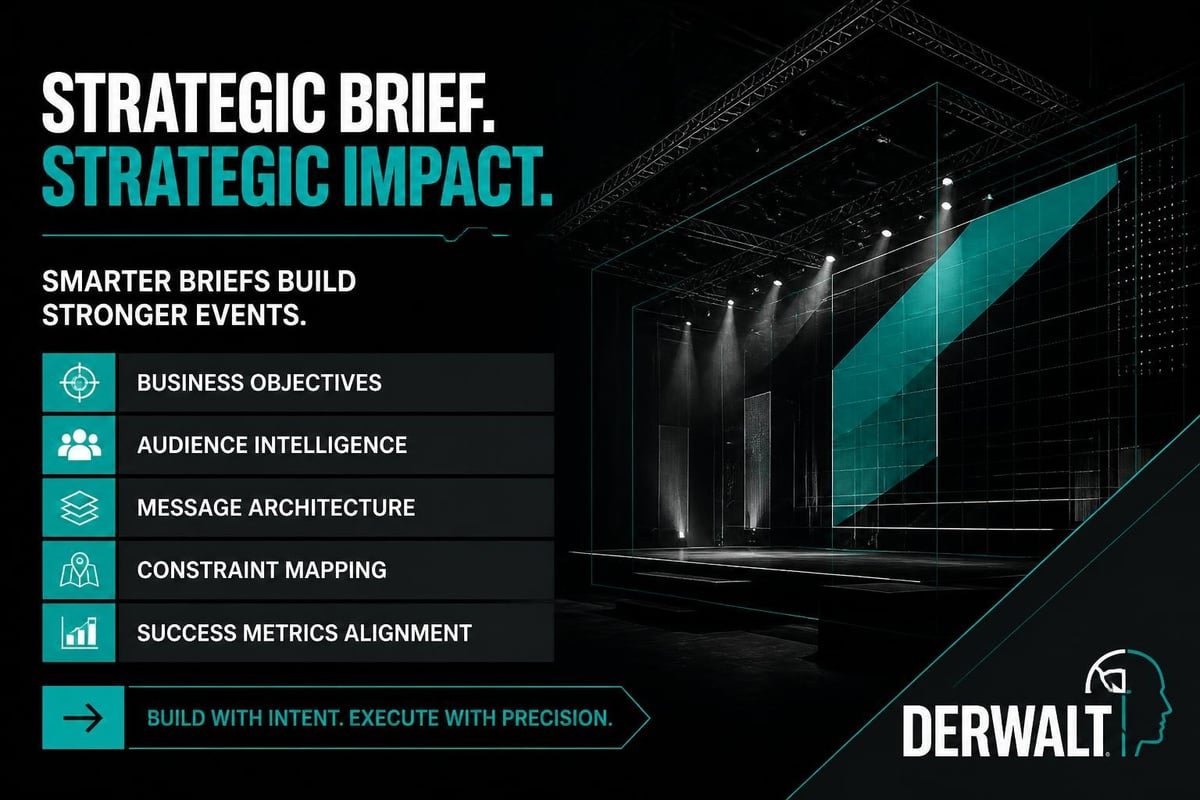
Every viable concept for event production begins with a comprehensive strategic brief. This document translates stakeholder aspirations into actionable parameters that guide creative development while maintaining commercial discipline.
The brief must answer fundamental questions with precision:
- What business outcome must this event achieve? (lead generation, brand repositioning, product launch, stakeholder engagement)
- Who comprises the target audience? (demographics, psychographics, behavioral patterns, decision-making authority)
- What message hierarchy supports the business objective? (primary positioning, secondary benefits, supporting proof points)
- What constraints govern execution? (budget ceiling, timeline, venue limitations, regulatory requirements)
- How will success be measured? (attendance metrics, engagement rates, conversion percentages, media value)
The strategic brief development process transforms abstract ambitions into concrete parameters. In practice, this requires facilitated stakeholder workshops that surface unstated assumptions, reconcile conflicting priorities, and establish shared definitions of success.
Audience Intelligence as Strategic Input
Understanding audience psychology shapes every dimension of concept development. Generic demographic data proves insufficient for creating resonant experiences. Effective concepts require behavioral insights: what motivates attendance decisions, which sensory experiences create memory formation, how social dynamics influence participation, and what post-event actions convert awareness into commercial value.
Primary research methods include stakeholder interviews, customer journey mapping, competitive event analysis, and social listening across relevant digital platforms. This intelligence reveals opportunity gaps where a differentiated concept for event execution can capture attention and drive measurable outcomes.
Conceptual Architecture: From Strategy to Creative Expression
With strategic parameters established, conceptual development translates business requirements into experiential frameworks. This phase demands equal parts creative imagination and production discipline. Ideas must inspire while remaining executable within defined constraints.
The conceptual architecture typically includes several interconnected layers:
| Conceptual Layer | Strategic Function | Execution Impact |
|---|---|---|
| Core Narrative | Establishes emotional throughline and message hierarchy | Guides content development, spatial design, and engagement sequencing |
| Thematic Framework | Creates recognizable identity and sensory consistency | Informs visual language, sound design, material selection, and brand integration |
| Engagement Mechanics | Defines how audiences interact with the experience | Shapes technology requirements, staffing models, and space allocation |
| Technical Envelope | Establishes production infrastructure requirements | Determines venue suitability, equipment specifications, and supplier capabilities |
The most effective concepts demonstrate internal logic where each element reinforces the others. When developing an event concept, this coherence creates both operational efficiency and experiential impact. Disconnected ideas, regardless of individual merit, fragment attention and complicate execution.
Creative Ideation Within Operational Reality
Creative exploration must occur within realistic boundaries. Unconstrained brainstorming generates ideas that cannot be executed within available resources, creating downstream friction when concepts require substantial revision during production planning.
Disciplined ideation establishes feasibility filters early in the process. Each conceptual element undergoes rapid feasibility assessment across five dimensions:
- Technical viability: Can this be built, operated, and maintained reliably?
- Budget compatibility: Does this fit within allocated resources including contingency?
- Timeline feasibility: Can procurement, fabrication, and installation occur within available schedule?
- Risk profile: What failure modes exist and can they be mitigated acceptably?
- Measurable impact: Will this element contribute to defined success metrics?
Ideas failing these filters require modification or elimination regardless of creative appeal. This discipline prevents the common scenario where attractive concepts prove unbuildable or financially unsustainable.
Production Intelligence: Translating Concept into Executable Plans
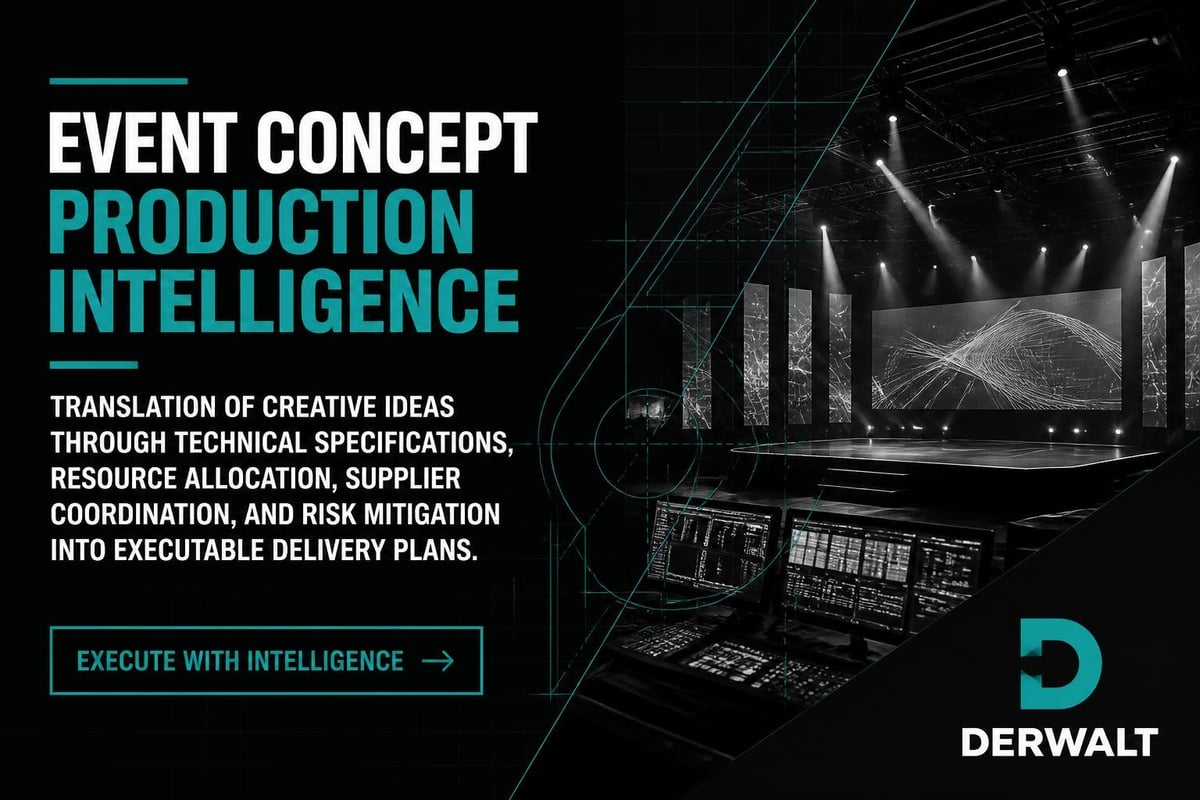
A concept for event success remains theoretical until translated into detailed production plans. This translation requires specialized expertise that bridges creative vision with operational reality. Production intelligence encompasses the systems, processes, and technical knowledge that ensure flawless execution.
The production planning phase decomposes the overarching concept into discrete, manageable workstreams. Each workstream receives detailed specifications, resource allocations, timeline milestones, quality standards, and contingency protocols. This granular planning transforms abstract ideas into concrete tasks with clear ownership and accountability.
Key production workstreams typically include:
- Spatial design and fabrication: Translating conceptual environments into technical drawings, material specifications, and construction schedules
- Technology integration: Specifying audio, visual, lighting, and interactive systems with redundancy planning
- Content production: Creating video, graphics, copywriting, and multimedia assets aligned with thematic frameworks
- Logistics coordination: Managing material flow, installation sequencing, and site access protocols
- Supplier orchestration: Aligning multiple specialist vendors within unified quality and timeline standards
When planning production processes, documentation discipline separates professional operations from amateur efforts. Every decision, specification, and commitment must be captured in accessible formats that enable team coordination and provide audit trails for quality control.
Risk Mitigation as Production Discipline
Every concept for event execution contains inherent risks across technical, operational, financial, and reputational dimensions. Production intelligence includes systematic risk identification, assessment, and mitigation planning before commitments become irreversible.
Effective risk management follows a structured methodology:
Identification: Catalog potential failure modes across all production elements through team workshops and historical analysis
Assessment: Evaluate each risk's probability and potential impact using standardized scoring frameworks
Mitigation: Develop specific countermeasures including technical redundancy, supplier alternatives, contingency budgets, and response protocols
Monitoring: Establish trigger points and responsibility assignments for activating contingency measures
The production planning phase at DERWALT integrates risk mitigation into baseline specifications rather than treating it as an afterthought. This approach ensures concepts remain deliverable even when unforeseen challenges emerge during execution.
Budget Architecture: Financial Discipline in Concept Development
Financial viability determines which concepts progress from ideation to execution. Budget architecture must be integrated into concept development from the earliest stages rather than imposed as an external constraint after creative decisions have been made.
A disciplined budget framework allocates resources across several categories while maintaining strategic flexibility:
| Budget Category | Typical Allocation | Strategic Considerations |
|---|---|---|
| Creative Development | 8-12% | Prototyping, design iteration, content production |
| Technical Infrastructure | 25-35% | AV systems, staging, lighting, power distribution |
| Fabrication & Build | 20-30% | Set construction, environmental design, installations |
| Logistics & Operations | 15-20% | Transport, installation labor, site management |
| Contingency Reserve | 10-15% | Risk mitigation, scope changes, unforeseen challenges |
Budget discipline requires continuous reconciliation between conceptual ambition and financial reality. When developing a concept for creative events, trade-off decisions must prioritize elements that directly support strategic objectives over those providing marginal aesthetic enhancement.
Value Engineering Without Compromising Impact
Value engineering identifies opportunities to reduce costs while maintaining or enhancing strategic impact. This differs fundamentally from arbitrary budget cuts that erode quality indiscriminately.
Effective value engineering examines each conceptual element through multiple lenses. Can alternative materials achieve the same visual effect at lower cost? Can modular design enable reuse across multiple activations? Can strategic supplier partnerships deliver volume discounts? Can timeline adjustments access off-peak pricing?
The most sophisticated concept development integrates value engineering into initial ideation rather than applying it reactively when budgets prove insufficient. This proactive approach expands creative possibilities rather than constraining them.
Technical Planning: Infrastructure for Experiential Delivery
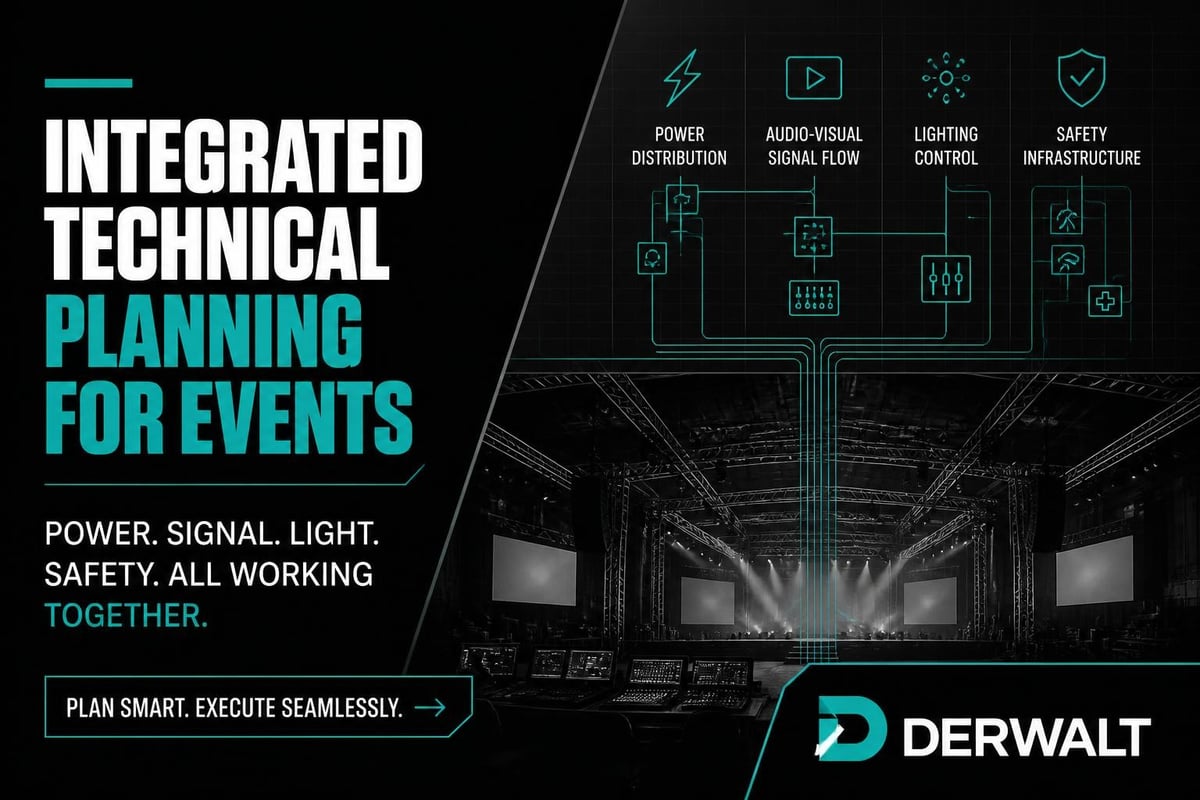
The technical dimension of concept development determines whether creative visions translate into reliable, high-quality audience experiences. Technical planning encompasses all systems required to deliver the intended experience: power distribution, audio reproduction, video display, lighting control, network connectivity, environmental conditioning, and safety infrastructure.
Technical specifications must balance performance requirements with operational constraints. Oversized systems waste budget and complicate logistics. Undersized systems risk failure during critical moments. Right-sizing requires detailed analysis of usage patterns, environmental conditions, audience densities, and failure mode implications.
Advanced technical planning includes:
- Load calculations: Determining power requirements including peak demand and redundancy needs
- Signal flow diagrams: Mapping audio, video, data, and control pathways with backup routing
- Rigging engineering: Calculating structural loads and safety factors for suspended elements
- Thermal management: Ensuring equipment operates within temperature specifications under load
- Acoustic modeling: Predicting sound coverage and intelligibility across the venue space
When developing technical event infrastructure, the planning phase prevents costly field modifications and ensures regulatory compliance. Detailed technical documentation enables efficient supplier coordination and reduces installation timelines.
Stakeholder Alignment: Managing Expectations Through Development
A concept for event success requires continuous stakeholder alignment throughout development. Creative evolution, budget refinement, and technical problem-solving generate decisions that affect strategic outcomes. Maintaining stakeholder confidence requires structured communication that provides transparency without overwhelming non-technical audiences.
Effective stakeholder management establishes clear decision rights and escalation protocols. Which decisions can the production team make autonomously? Which require stakeholder consultation? What thresholds trigger formal approval processes? Ambiguity in these areas generates friction, delays, and scope creep.
Regular milestone reviews present development progress using visualization tools that make abstract concepts tangible:
- 3D renderings showing spatial layouts and sightlines from audience perspectives
- Mood boards communicating aesthetic direction through reference imagery and material samples
- Journey maps illustrating attendee experiences across arrival, engagement, and departure phases
- Budget dashboards tracking allocations against categories with variance explanations
The review cadence balances the need for stakeholder input against the requirement for production momentum. Too frequent reviews create decision fatigue and slow progress. Insufficient reviews allow misalignment to compound until corrections become expensive.
Activation Strategy: Connecting Concept to Commercial Outcomes
The ultimate test of any concept for event delivery lies in measurable business results. Activation strategy connects experiential elements to commercial objectives through deliberate engagement design and post-event conversion planning.
Effective activation begins with understanding the attendee decision journey. What awareness must exist before the event? What experience during the event shifts perception or creates desire? What mechanisms enable post-event action? Each touchpoint requires intentional design aligned with commercial goals.
Pre-event activation generates qualified attendance through targeted outreach across appropriate channels. The concept itself shapes messaging strategy. Does the event promise exclusive access, educational value, networking opportunities, or entertainment? Promise-delivery alignment builds credibility that supports post-event conversion.
During-event activation maximizes engagement through mechanics that feel organic rather than forced. The most successful approaches integrate commercial objectives into experiences audiences want to participate in voluntarily. Interactive demonstrations, gamified challenges, personalized consultations, and social sharing opportunities create value exchange rather than one-way promotion.
Post-event activation captures momentum through rapid follow-up while experiences remain fresh in attendee memory. Lead qualification, content distribution, relationship nurturing, and conversion tracking transform ephemeral experiences into lasting commercial relationships. DERWALT's approach to comprehensive production management ensures activation strategy receives equal rigor to creative and technical planning.
Measurement Framework: Quantifying Concept Performance
A robust concept for event execution includes measurement frameworks established during planning rather than improvised after completion. Measurement strategy defines which metrics indicate success, how data will be captured, and what analysis will inform future optimization.
Event measurement typically spans multiple metric categories:
| Metric Category | Example Indicators | Strategic Value |
|---|---|---|
| Attendance | Registration conversion, actual attendance, dwell time | Audience reach and engagement depth |
| Engagement | Interaction rates, content consumption, sharing activity | Message resonance and participation quality |
| Perception | Brand awareness shifts, attribute association changes | Positioning effectiveness |
| Commercial | Lead generation, conversion rates, revenue attribution | Direct business impact |
| Operational | Budget variance, timeline adherence, incident frequency | Execution quality and efficiency |
Measurement infrastructure must be designed into the concept from inception. Interactive elements require tracking mechanisms. Attendee journeys need observation protocols. Perception changes demand pre- and post-event research. Commercial outcomes require attribution systems connecting event exposure to subsequent behavior.
The most valuable measurement approaches enable real-time optimization during execution. When monitoring reveals unexpected attendance patterns, content can be adjusted. When engagement metrics underperform, activation tactics can be modified. This adaptive capability transforms measurement from retrospective analysis into active performance management.
Iteration and Refinement: Continuous Concept Evolution
The strongest concepts for event success emerge through iterative refinement rather than single creative breakthroughs. Initial ideas undergo testing, feedback, modification, and enhancement across multiple development cycles before reaching final specification.
Iteration follows a disciplined process. Each concept version undergoes structured evaluation against strategic criteria, operational feasibility, budget compatibility, and stakeholder requirements. Weaknesses identified through evaluation trigger specific modifications. Enhanced versions undergo re-evaluation until all critical requirements are satisfied.
Physical prototyping accelerates concept refinement by making abstract ideas tangible. Mockups reveal spatial relationships, scale perceptions, material aesthetics, and interaction ergonomics that remain unclear in drawings or descriptions. Early prototyping identifies design flaws when corrections remain inexpensive.
Digital prototyping through 3D modeling and virtual reality enables stakeholder immersion in proposed experiences before physical construction begins. This visualization capability reduces misunderstanding, builds confidence, and surfaces concerns that might otherwise emerge during installation when corrections become costly.
The refinement process documented through event design development requires balancing perfectionism against schedule realities. Iteration must occur within defined timeframes that preserve adequate production runway. Disciplined teams establish version control, freeze dates, and change management protocols that prevent endless refinement from undermining execution quality.
Integration Excellence: Orchestrating Multi-Vendor Delivery
Complex events require coordination across multiple specialist suppliers, each contributing distinct capabilities to the unified experience. A concept for event delivery must account for integration complexity during planning rather than assuming seamless collaboration will occur organically.
Integration planning begins with clear interface definitions between supplier scopes. Where does audio responsibility end and lighting begin? Who owns power distribution to third-party equipment? What coordination protocols govern shared installation windows? Ambiguity in these areas generates conflicts, delays, and quality compromises.
Lead production coordination establishes unified standards across all suppliers regarding documentation formats, communication protocols, quality benchmarks, timeline adherence, and site conduct. This standardization enables efficient collaboration even when individual suppliers have never previously worked together.
Technical integration requires particular attention. Audio, video, lighting, and interactive systems must function as unified environments rather than independent installations. Signal routing, timing synchronization, control integration, and aesthetic coherence demand coordinated design that considers the complete technical ecosystem.
When managing 360-degree production delivery, integration discipline separates professional execution from chaotic implementations where suppliers optimize their individual scopes without regard for collective outcomes.
Execution Readiness: Transition from Planning to Delivery
The transition from concept development to on-site execution represents a critical phase where theoretical plans encounter physical reality. Execution readiness requires systematic verification that all prerequisites for successful delivery have been satisfied.
A comprehensive readiness assessment examines multiple dimensions:
- Documentation completeness: All technical specifications, site plans, schedules, and procedures finalized and distributed
- Resource confirmation: All suppliers, personnel, materials, and equipment committed with verified availability
- Site preparation: Venue access secured, infrastructure verified, permits obtained, safety protocols established
- Contingency activation: Backup plans documented, alternative suppliers identified, emergency contacts distributed
- Communication architecture: All team members understand roles, reporting structures, escalation protocols, and coordination mechanisms
Formal readiness reviews conducted 72-96 hours before load-in create opportunity to address gaps before they impact execution. Issues identified during these reviews typically remain solvable with modest effort. The same issues discovered during installation create disproportionate stress and cost.
The execution phase validates whether the concept for event delivery was grounded in operational reality or based on unrealistic assumptions. Well-developed concepts execute smoothly because potential problems were anticipated and addressed during planning. Poorly developed concepts generate constant firefighting as unforeseen issues emerge.
Learning Capture: Extracting Value from Execution Experience
Every event execution generates learning that should inform future concept development. Systematic post-event analysis captures this knowledge before team dispersion and fading memory reduce accessibility.
Effective post-event analysis addresses several questions through structured debriefs with all stakeholder groups:
What worked exceptionally well and should be replicated? Document specific approaches, suppliers, technologies, or processes that exceeded expectations.
What underperformed relative to expectations and requires improvement? Identify root causes rather than symptoms to enable genuine corrective action.
What unforeseen challenges emerged and how were they resolved? Capture institutional knowledge about adaptive problem-solving for future reference.
What stakeholder feedback reveals opportunities for enhancement? Incorporate attendee, client, and team perspectives into continuous improvement.
What budget and timeline variances occurred and what drove them? Understand financial and schedule performance to improve future estimation accuracy.
Learning documentation creates organizational memory that compounds over time. Teams developing subsequent concepts access accumulated wisdom rather than repeatedly learning identical lessons. This knowledge infrastructure accelerates development, reduces risk, and enhances creative possibility by freeing cognitive capacity from solving previously addressed challenges.
The comprehensive approach to event concept development recognizes that each activation contributes to a broader evolution of capability, methodology, and competitive advantage.
Strategic concept development determines whether brand experiences deliver measurable business value or merely consume budget without commercial return. The framework outlined here provides structure for translating stakeholder objectives into executable reality through disciplined planning, technical rigor, and operational excellence. When your organization requires a partner that bridges creative vision with flawless production delivery, DERWALT brings the production intelligence, strategic discipline, and execution capability to transform concepts into commercially successful brand experiences across South Africa.
Recent Comments