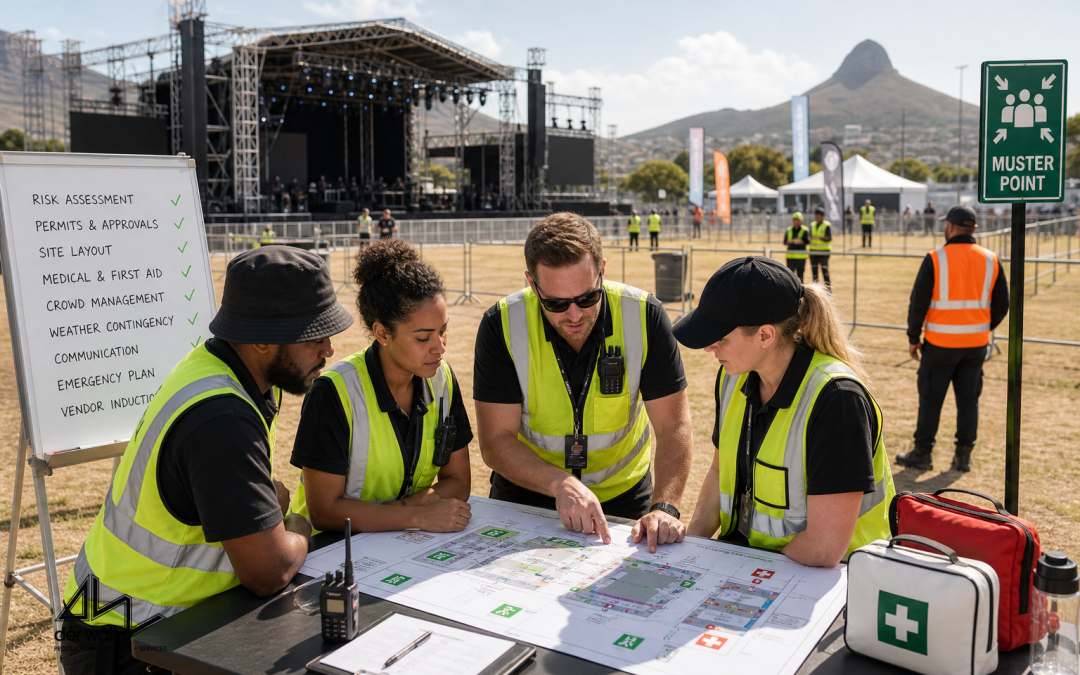
How to Build a Practical Safety Plan for Large-Scale Experiential Events
A practical, risk-based safety plan is essential for large experiential events in South Africa. This guide outlines a step-by-step approach—from risk assessment to on-site controls and emergency readiness—for brands, agencies and venues.
The direct answer: begin with a formal Hazard Identification and Risk Assessment (HIRA) and translate that into a written safety plan with clear on-site controls, inductions, and emergency procedures aligned to local regulations. Then implement it through roles, training, and rehearsals to keep people safe while delivering a compelling experience.
Why safety planning matters for experiential activations
Experiential events blend spectacle with crowd dynamics, variable environments and multiple stakeholders. Without a rigorous safety plan, risks from crowd movement, structure loads, weather, electrical systems, and contractors can escalate quickly. In South Africa, events also navigate weather variability, traffic management requirements, access controls, and local permitting processes. A robust safety plan helps protect attendees, staff and partners while safeguarding the event’s schedule and budget.
Good safety planning isn’t a one-off document; it’s a living framework. It should inform site selection, design decisions, vendor contracts, and on-site execution. When done well, safety planning improves reliability, speeds up approvals, and ultimately enhances the audience experience by reducing interruptions and increasing confidence among stakeholders.
A practical safety planning workflow for South African events
- Define scope, responsibilities and regulatory obligations. Identify all areas of risk (site, structure, crowd, electrical, fire, medical, transport, weather) and assign a clear Safety Lead, Site Controller, and Medical Lead. Confirm required permits, road closures, and venue approvals with the local authority and SASREA-compliance considerations where applicable.
- Conduct Hazard Identification and Risk Assessment (HIRA). Systematically identify hazards, assess likelihood and consequence, and determine risk controls. Use a simple scoring framework and document residual risk after controls. For events, create a risk register that’s kept on-site for quick reference.
-
Develop a written safety plan and on-site controls. The plan should cover:
- Site layout with emergency egress, muster points, and load paths for equipment
- Electrical installation safety, lockout/tagout practices, and servicing windows
- Fire prevention and extinguishers, smoke and heat detection where relevant
- Medical and first-aid provision, including on-site personnel and evacuation routes
- Security, crowd management, and access control measures
- Weather contingency planning (heat, storms, lightning, rain) and contingency routes
- Vendor management: permit-to-work, safety briefings, and site-specific inductions
- Plan for permits, traffic and access. Obtain road-closure permits, traffic management plans, and municipal approvals as needed. Coordinate with transport providers and local authorities to ensure safe vehicle movement, parking, and pedestrian routes.
- Define roles and training requirements. Establish a Safety Manager, Site Controller, Crowd Manager, Medical Lead, and on-site technicians. Deliver a concise site induction in the languages used by staff and volunteers, covering emergency procedures, communication protocols, and muster points.
- Establish an emergency response framework. Create clear escalation paths, contact lists for emergency services, a dedicated incident log, and a rehearsal plan. Include procedures for medical emergencies, crowd crush scenarios, fire, and severe weather events.
- Contractor and vendor management. Require pre-qualification, safety documentation (method statements, risk assessments, permits for hot work), and a safety briefing prior to work. Ensure contractors understand site hazards and reporting requirements.
- Weather readiness and contingency planning. South Africa’s climate can bring rapid weather changes. Build timelines and staging that can be adjusted for heat, wind, lightning, or rain. Maintain backup power and lighting where feasible and designate shelter points.
- Documentation, records and audit trails. Keep the safety plan, HIRA, site drawings, permit records, training logs, and incident reports in a common-access location. Documentation supports compliance, vendor management and post-event learnings.
- On-site safety execution and continuous improvement. Run site inductions, tool-box talks, daily briefings, and walk-throughs with the leadership team. Use real-time checks and maintain an incident-reporting cadence to capture near-misses and lessons learned.
Key terms you’ll encounter
Hazard Identification and Risk Assessment (HIRA) is a systematic process to identify hazards, determine risk levels, and implement controls to reduce risk to an acceptable level. It’s the backbone of event safety planning.
Permit to Work (PTW) is a formal process ensuring that high-risk tasks (e.g., electrical work, hot work, confined-space work) are planned, supervised, and safely executed with appropriate authorisation and controls.
Emergency response plan outlines how to react to incidents, including who contacts what services, how to communicate with attendees, where to evacuate, and how to resume operations.
Practical safety checklist for event teams
- Written safety plan signed by the event lead and Safety Manager
- HIRA completed with residual risk documented
- Permits and approvals in place (municipal, traffic, road closures, venue-specific)
- Site layout with clearly marked exits, muster points, and access routes
- On-site medical team and first-aid kits ready; EMS contact information on hand
- Qualified electrical and rigging professionals; PTW where needed
- Staff induction completed; multilingual materials available
- Weather contingency plans reviewed; shelter points identified
- Communication plan and public address system tested
- Incident logging and post-event debrief process defined
Common pitfalls and considerations
- Underestimating weather risks or failing to plan for extreme heat or storms
- Incomplete permits or misaligned traffic management plans
- Missing or poorly communicated emergency procedures
- Assuming staff or volunteers understand safety expectations without induction
- Overlooking accessibility for guests with mobility or sensory needs
FAQ
What is HIRA and why is it essential for events?
Hazard Identification and Risk Assessment (HIRA) is a structured process to identify hazards, evaluate risk, and define controls—central to keeping events safe and compliant.
How should a safety plan be structured for a large activation?
Start with scope, roles, and legal obligations; add a live risk register (HIRA); define controls, emergency plans, training, and contractor management; then codify it in a written plan and rehearse.
What permits are typically required for South African outdoor events?
Permits usually include road closures or traffic management approvals, venue-specific permissions, and any local by-law approvals. Always check with the local municipality and venue for a definitive list.
How do you coordinate medical services on site?
Establish an on-site medical lead, ensure first-aid staff are trained and equipped, and have a clear incident escalation path to external emergency services.
What are best practices for weather contingency planning?
Build flexible staging, shelter options, backup power, and clear communication about closures or delays. Regular weather monitoring and a predefined decision tree help maintain safety and schedule integrity.
How do you ensure vendors understand safety requirements?
Require pre-qualification, safety documentation, and a formal safety briefing before work begins; include safety expectations in contracts and site inductions.
Sources
- Event safety – Health and Safety Executive (HSE) — United Kingdom
- The Purple Guide to Health, Safety and Welfare at Live Events — Purple Guide
- ISO 45001: Occupational health and safety management systems — International Organization for Standardization
- Department of Employment and Labour (South Africa) – Occupational health and safety overview — SA Government
- NFPA — National Fire Protection Association
Call to Action
Ready to plan a safe, unforgettable experiential activation? DERWALT partners with brands and agencies to design end-to-end safety-driven experiences—from strategy and risk assessment to on-site production and post-event review. Contact us to discuss your next activation.
Recent Comments