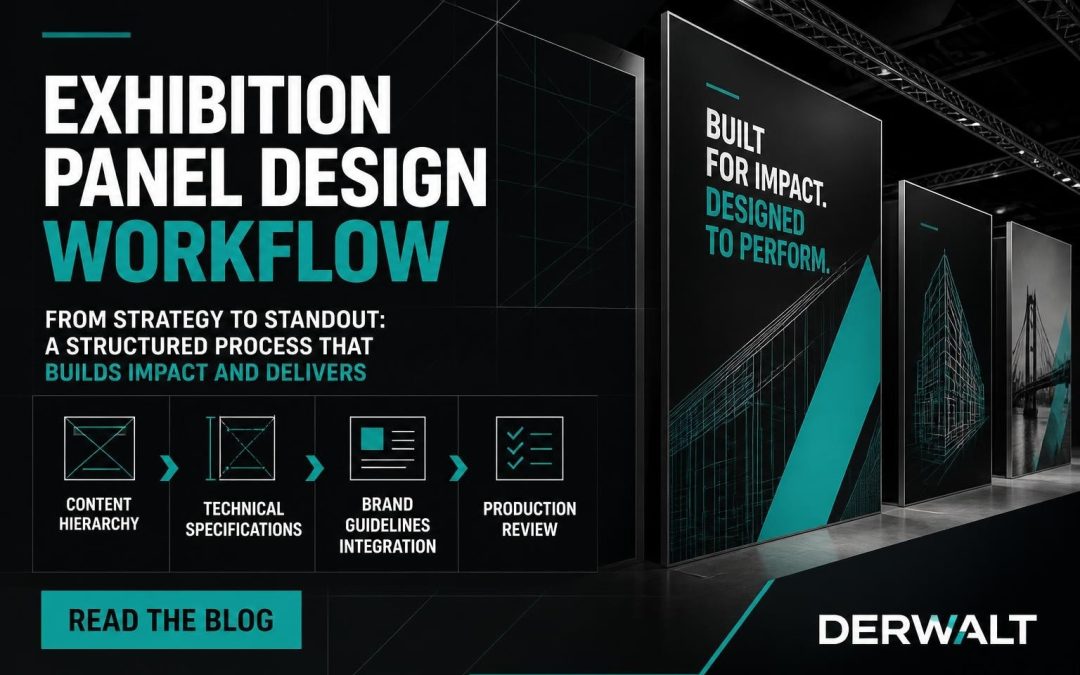
Exhibition panel design represents a critical intersection between brand communication and spatial experience design. For production teams managing brand activations and experiential marketing campaigns, panels serve as strategic touchpoints that guide audience behavior, reinforce messaging, and create measurable engagement opportunities. The difference between generic signage and intelligent panel design lies in production planning, technical precision, and strategic content architecture.
Strategic Foundation for Panel Development
Exhibition panel design begins with understanding brand objectives and spatial constraints before any visual development occurs. Production intelligence demands a clear brief that defines target audience behavior, key messages, technical limitations, and budget parameters.
Critical briefing elements include:
- Brand guidelines and approved visual assets
- Spatial dimensions and mounting requirements
- Viewing distances and audience flow patterns
- Production timelines and approval processes
- Budget allocation for materials and installation
The Western Australian Museum panel writing guidelines emphasize the importance of concise text and engaging storytelling, principles equally applicable to commercial brand activations. Production teams must balance creative ambition with practical constraints, ensuring every panel supports broader event objectives while remaining feasible within technical and financial boundaries.
Content Architecture and Hierarchy
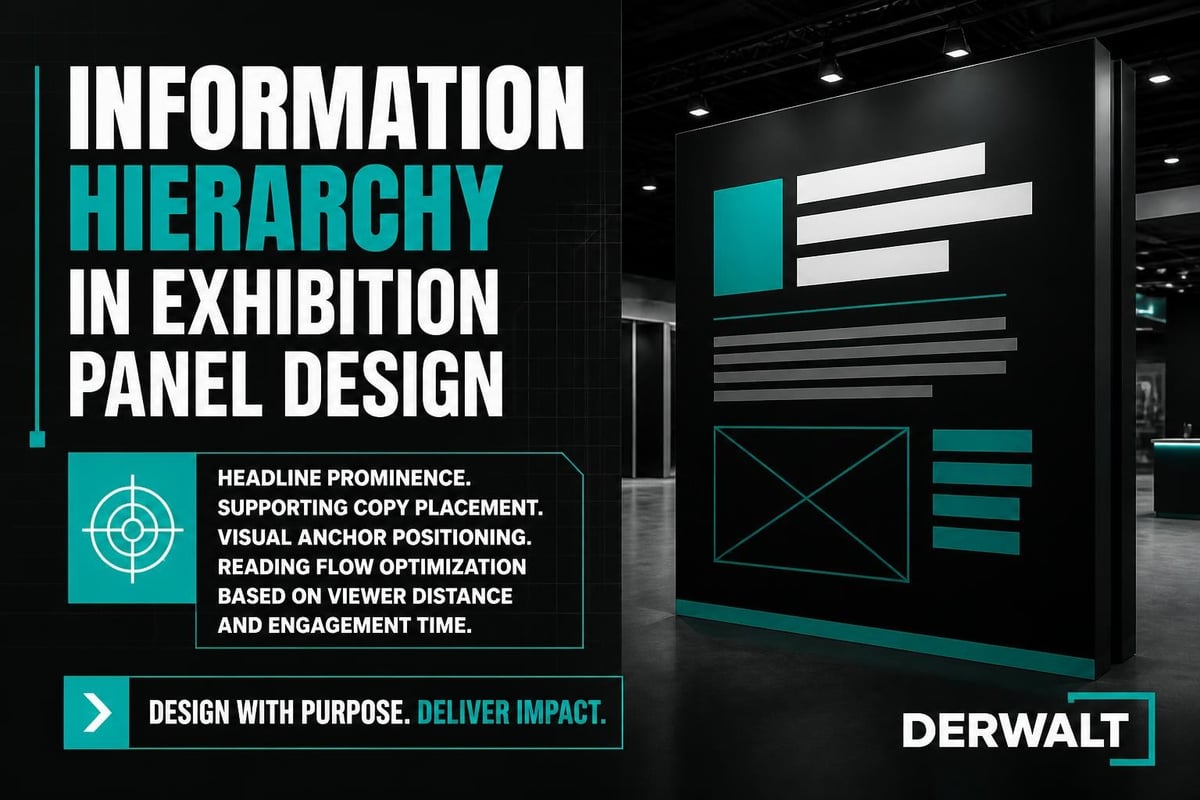
Information hierarchy determines panel effectiveness more than aesthetic treatment alone. Strategic content structure guides viewer attention through deliberate sequencing, visual weighting, and spatial organization.
Primary content elements typically include headlines that communicate core messages within three seconds, supporting copy that provides essential context without overwhelming readers, and visual anchors such as brand marks, product images, or data visualizations. Each element requires specific positioning based on typical viewing angles and distances.
| Content Type | Recommended Size | Viewing Distance | Engagement Time |
|---|---|---|---|
| Primary Headline | 100-150mm height | 5-10 meters | 2-3 seconds |
| Secondary Copy | 40-60mm height | 2-4 meters | 5-10 seconds |
| Body Text | 20-30mm height | 1-2 meters | 15-30 seconds |
| Fine Print | 12-18mm height | 0.5-1 meter | Variable |
The British Columbia Museums Association exhibit panel design guide provides practical templates and layout principles that translate effectively to commercial applications. Production teams should adapt these frameworks rather than starting from blank canvases, accelerating development while maintaining proven effectiveness.
Technical Specifications and Production Requirements
Exhibition panel design must account for manufacturing processes, material limitations, and installation logistics from initial concept stages. Production intelligence means designing within feasible parameters rather than creating impossible specifications that require expensive revisions.
Material Selection and Durability
Material choices directly impact visual quality, longevity, and production costs. Each substrate offers distinct advantages depending on event duration, environmental conditions, and budget constraints.
Common panel materials include:
- Foamboard: lightweight, cost-effective for short-term indoor events
- Dibond: aluminum composite providing rigidity for semi-permanent installations
- Acrylic: premium finish with excellent color reproduction and durability
- Fabric systems: tension-based solutions enabling tool-free installation
- Vinyl on substrate: flexible application for curved or irregular surfaces
Environmental factors such as outdoor exposure, humidity levels, and temperature fluctuations require material specifications that prevent warping, fading, or delamination. Production teams managing multi-day activations should specify UV-resistant inks and weather-rated substrates even for partially covered installations, as indirect exposure can cause rapid degradation.
The technical planning phase should address mounting methods, weight distribution, and structural support requirements. Panels exceeding 2.4 meters in any dimension typically require reinforced backing or frame systems to prevent bowing, while installations in high-traffic areas need impact-resistant materials and secure fastening methods.
Visual Design Principles for Brand Environments
Exhibition panel design operates within broader brand experience strategies, requiring visual consistency across touchpoints while optimizing for specific viewing conditions and audience behaviors. Strategic design decisions enhance brand recognition and message retention without compromising production feasibility.
Typography and Readability
Font selection impacts both aesthetic alignment and functional performance. Production specifications must balance brand guidelines with legibility requirements across varied viewing distances.
Sans-serif typefaces generally provide superior readability for exhibition panels, particularly at distances exceeding three meters. While branded serif fonts may be appropriate for headlines, body copy benefits from clean, open letterforms with adequate x-height. Minimum stroke width should exceed 2mm at final output size to prevent thin elements from disappearing under typical viewing conditions.
Typography specifications for optimal performance:
- Line length should not exceed 60 characters for comfortable reading
- Line spacing (leading) should equal 120-150% of font size
- Character spacing requires adjustment at large scales to prevent visual gaps
- All-caps text reduces reading speed by approximately 13% compared to sentence case
Color contrast ratios must meet WCAG 2.1 accessibility standards even when legal compliance is not mandated, as inadequate contrast reduces legibility for all viewers regardless of visual ability. Production teams should verify contrast using digital tools during design phases rather than relying on screen appearance, as printing processes and lighting conditions alter perceived contrast significantly.
Brand Integration and Visual Consistency
Exhibition panel design extends brand systems into three-dimensional environments, requiring thoughtful adaptation of two-dimensional guidelines. Production intelligence recognizes when strict adherence to existing standards creates ineffective outcomes and when strategic flexibility enhances brand presence.
DERWALT’s experiential marketing expertise demonstrates how production teams translate brand assets into impactful spatial experiences that maintain consistency while optimizing for environmental contexts. This approach ensures panels function as integrated brand touchpoints rather than isolated graphic elements.
| Design Element | Brand Standard | Panel Adaptation | Rationale |
|---|---|---|---|
| Primary Palette | RGB digital colors | CMYK or Pantone equivalents | Print process compatibility |
| Logo Sizing | Minimum 10mm | Scaled to viewing distance | Visibility optimization |
| Image Resolution | 72 DPI web | 150+ DPI print | Output quality requirements |
| Layout Grid | 12-column digital | Custom spatial grid | Physical dimensions |
Production specifications should document approved adaptations, ensuring consistency across panel sets while preventing unauthorized deviations. This documentation becomes particularly critical when multiple suppliers handle different production elements or when panel sets require updates across extended activation periods.
Production Planning and Quality Control
Exhibition panel design success depends on rigorous production management that prevents errors, controls costs, and ensures on-schedule delivery. Strategic planning begins during concept development rather than after design approval, integrating production realities into creative decisions.
Supplier Management and Specification Communication
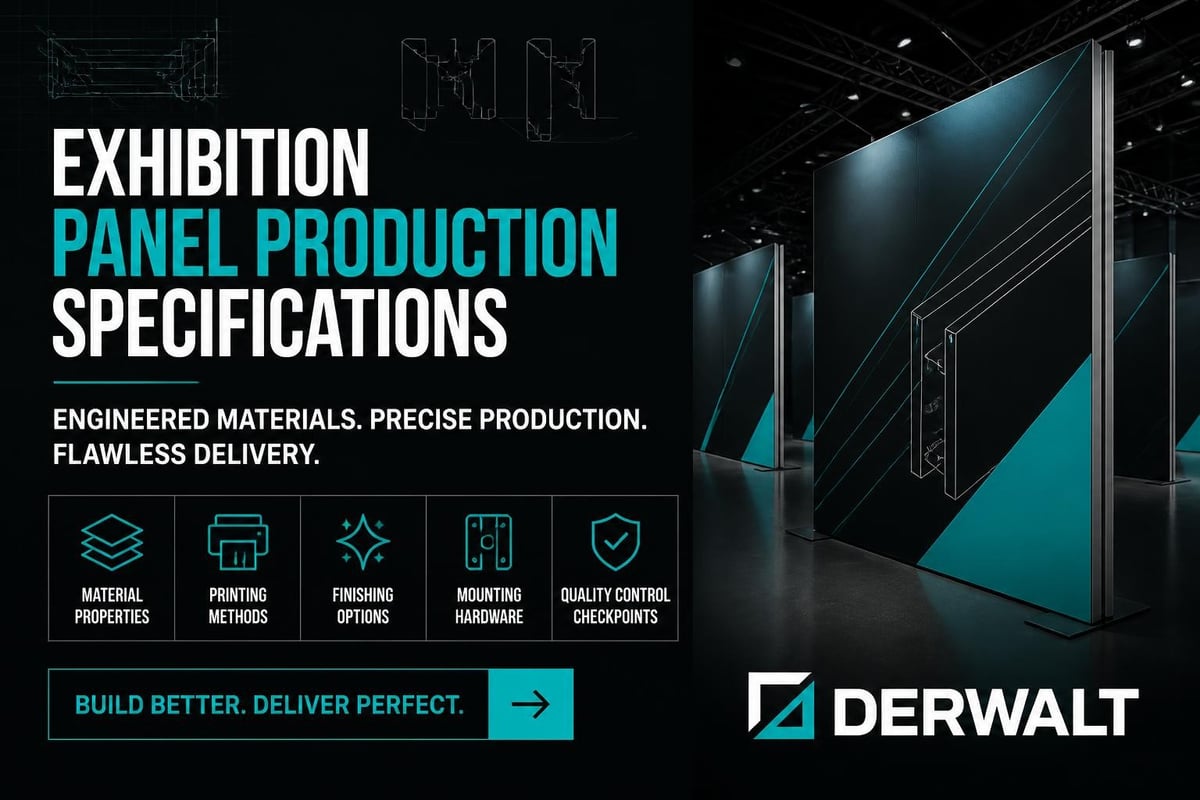
Clear technical specifications eliminate ambiguity that causes production errors and expensive corrections. Comprehensive print-ready files should include exact dimensions with bleed allowances, color specifications in appropriate formats, material requirements with acceptable alternatives, mounting hardware specifications, and installation instructions with spatial context.
DERWALT’s production management approach demonstrates how production intelligence reduces risk through detailed supplier briefings and milestone-based quality verification. This systematic approach prevents common failures such as incorrect color matching, dimensional errors, or unsuitable material substitutions.
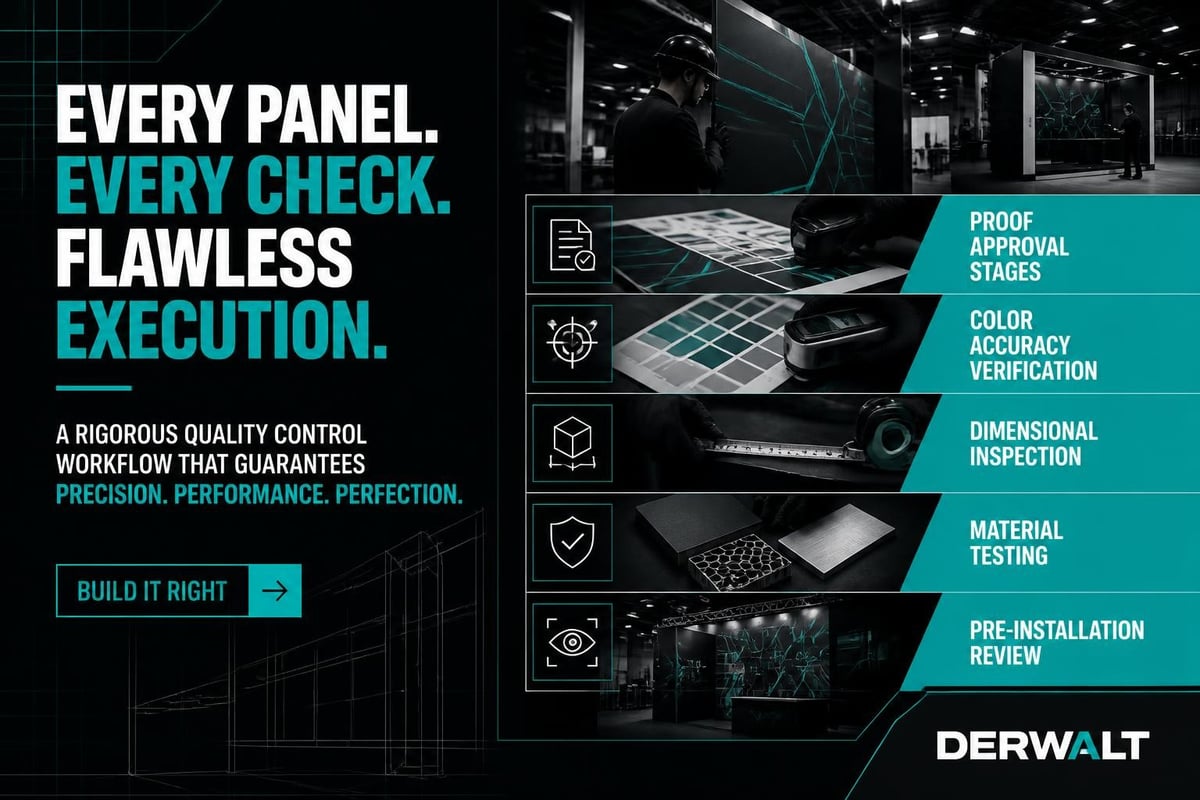
Production timelines must account for proof approval cycles, manufacturing lead times, delivery logistics, and installation schedules. Rush production invariably increases costs and error rates, making realistic scheduling a cost-control measure rather than mere project management.
Installation Logistics and Site Preparation
Exhibition panel design must consider installation methodologies and site conditions that affect feasibility and final appearance. Production teams should conduct site surveys before finalizing designs, documenting structural attachment points, electrical access for illuminated panels, clearance heights, and floor load capacities.
Installation efficiency directly impacts labor costs and setup timelines. Modular panel systems with standardized mounting hardware enable faster installation and simpler storage between activations, reducing total cost of ownership for recurring campaigns. The NADA exhibit design regulations provide industry-standard specifications that ensure consistent quality and safety compliance across installations.
Pre-installation checklist components:
- Verify all panels against specifications and quantities
- Inspect for production defects or shipping damage
- Test mounting hardware and confirm structural compatibility
- Review installation sequence and spatial relationships
- Confirm lighting positions and angles for optimal visibility
Content Development and Message Optimization
Exhibition panel design effectiveness depends on strategic content development that balances informational goals with audience attention limitations. Production intelligence recognizes that viewers engage with panels for seconds rather than minutes, requiring ruthless message prioritization.
Writing for Scanning Behavior
Audience research consistently demonstrates that exhibition visitors scan rather than read panels, extracting key information through headlines, highlighted terms, and visual elements. Content structure must support this behavior rather than expecting sustained reading.
Effective panel copy uses active voice for immediacy, present tense for relevance, and concrete language over abstract concepts. Sentence length should average 15-20 words, with complex ideas broken into multiple short statements rather than compound sentences. Bullet points and numbered lists enable rapid information extraction, though excessive use creates visual clutter that reduces overall effectiveness.
The inverted pyramid structure places critical information first, followed by supporting details, then contextual background. This approach ensures viewers who disengage after initial seconds still receive primary messages, while those with deeper interest find additional content naturally.
Data Visualization and Information Graphics
Complex information requires visual translation to enable rapid comprehension. Strategic data visualization transforms statistics, processes, and relationships into scannable graphics that communicate faster than equivalent text.
Production specifications for infographics must account for viewing distances and resolution requirements. Charts and diagrams designed for digital screens typically fail at exhibition scale, requiring complete redesign rather than simple enlargement. Line weights below 1mm at final size become invisible beyond two meters, while subtle color distinctions disappear under typical exhibition lighting.
Integration with Broader Event Production
Exhibition panel design functions as one component within comprehensive event production strategies. Panels must coordinate with spatial design, lighting systems, audio elements, and interactive installations to create cohesive brand experiences.
Spatial Planning and Audience Flow
Panel positioning influences visitor movement patterns and engagement sequences. Strategic placement creates natural pathways, controls viewing order, and manages crowd density at key activation points.
High-traffic areas require panels with immediate visual impact and minimal reading requirements, as extended engagement blocks circulation and frustrates other visitors. Detailed information panels perform better in alcoves or secondary zones where viewers can spend time without disrupting flow.
DERWALT does not simply build events-DERWALT builds the system behind successful brand experiences. This systematic approach integrates exhibition panel design with spatial planning, technical infrastructure, and audience management strategies that transform individual elements into coherent brand narratives. Production intelligence ensures panels support broader objectives rather than existing as isolated communications.
Multi-Panel Narratives and Content Sequencing
Panel sets that tell stories across multiple touchpoints require careful content architecture and visual continuity. Sequential numbering, consistent visual frameworks, and progressive information revelation guide audiences through intended narratives while allowing non-linear exploration.
Color coding, shape systems, or graphic devices can distinguish content categories without requiring explicit labeling, enabling intuitive navigation for diverse audiences. These systems must remain simple enough for immediate comprehension while sophisticated enough to organize complex information hierarchies.
Measurement and Optimization
Exhibition panel design effectiveness should be evaluated through defined metrics that inform future optimization. Production intelligence demands measurable outcomes rather than subjective assessments, enabling data-driven refinement across campaigns.
Performance Metrics and Assessment Methods
Direct observation during activations provides qualitative insights into panel effectiveness. Trained observers can document engagement duration, reading behavior, and subsequent actions, identifying which panels succeed and which fail to capture attention.
Quantitative methods include heat mapping technology that tracks viewing patterns, dwell time measurements at specific panel locations, and post-event surveys that assess message recall and comprehension. These approaches require planning during initial design phases rather than retrofitting measurement after installation.
Key performance indicators for panel effectiveness:
| Metric | Measurement Method | Target Benchmark | Optimization Action |
|---|---|---|---|
| Attention Capture | Observation percentage | >60% of passersby | Headline revision |
| Engagement Duration | Average dwell time | 15-30 seconds | Content adjustment |
| Message Recall | Post-interaction survey | >40% unprompted | Hierarchy refinement |
| Action Completion | Tracked conversions | Campaign-specific | CTA optimization |
Iterative Refinement and Template Development
Successful exhibition panel design creates reusable frameworks that reduce future development costs while maintaining effectiveness. Production teams should document performance data and design specifications for high-performing panels, creating libraries of proven templates that accelerate subsequent projects.
Template systems enable consistent quality across campaigns while reducing design costs and production timelines. However, templates require periodic updating to prevent visual stagnation and incorporate emerging best practices. Annual reviews should assess template performance and identify refinement opportunities.
Regulatory Compliance and Safety Considerations
Exhibition panel design must address regulatory requirements and safety standards that vary by venue, event type, and jurisdiction. Production planning should verify compliance requirements early in development, as retrospective modifications increase costs substantially.
Fire safety regulations typically require flame-retardant materials or treatments for panels in public spaces. Certification documentation should be maintained for all materials and available for venue inspection. Some jurisdictions mandate specific ratings or testing protocols, requiring coordination with suppliers to ensure compliant sourcing.
Structural safety considerations include wind loading for outdoor installations, seismic requirements in certain regions, and crowd safety in high-density environments. Panels positioned above head height require engineering verification and secure mounting systems that prevent detachment under foreseeable conditions.
The CEATEC exhibition manual specifications provide standardized base panel outlines and installation guidelines that ensure consistency and safety across exhibition environments. While developed for trade shows, these principles apply broadly to brand activations and experiential marketing installations.
Sustainability and Environmental Responsibility
Exhibition panel design increasingly incorporates sustainability considerations as clients demand environmentally responsible event production. Material selection, production processes, and end-of-life planning affect environmental impact significantly.
Reusable panel systems with modular content inserts reduce waste across multiple activations. Base panels with substantial construction can receive updated graphics through removable vinyl or magnetic attachment systems, extending usable life while enabling message updates. This approach reduces material consumption while lowering total cost of ownership.
Material sourcing should prioritize recyclable substrates, water-based inks, and suppliers with documented environmental management systems. While sustainable options may carry premium costs, many clients consider environmental performance a competitive differentiator worth additional investment.
Transportation logistics contribute substantially to carbon footprints for traveling exhibitions. Lightweight materials reduce shipping costs and emissions, while collapsible or nesting designs improve transport efficiency. Production planning should calculate environmental impacts alongside financial costs, enabling informed decision-making.
Exhibition panel design demands strategic integration of brand communication, technical production, and spatial experience planning to create effective audience touchpoints. Success requires production intelligence that balances creative ambition with practical constraints, ensuring every panel supports measurable brand objectives while remaining feasible within budget and timeline parameters. DERWALT brings comprehensive production management expertise to exhibition panel design, transforming strategic concepts into flawlessly executed brand experiences through systematic planning, supplier coordination, and technical precision across South Africa's most demanding live events.
Recent Comments