How to Build a Practical Safety Plan for Large-Scale South African Events
A practical, field-ready safety framework for South Africa’s large events—balancing risk assessment, governance, emergency planning and onboarding suppliers. Learn the essential steps to keep crowds, staff and venues safe.
The foundation of any successful large-scale event in South Africa is a written safety plan built on a formal risk assessment, clear governance, and robust on-site procedures. Align these with international guidance and local practice to ensure coverage from planning to post-event debrief.
Why a formal safety plan matters for South African events
SA gigs, festivals and brand activations operate in a complex landscape: weather variability, transport constraints, permit requirements, and diverse audiences. A formal safety plan does more than tick a box; it provides a single source of truth for organisers, venues, suppliers and authorities. It helps you anticipate hazards, allocate responsibilities, and run rehearsals that reveal gaps before doors open.
Key benefits include improved communication during crisis, predictable decision-making during weather events, and a clearer chain of command for on-site staff and volunteers. It also supports contractual clarity with suppliers and helps demonstrate compliance to venue management and authorities.
A practical, step-by-step safety framework
1. Conduct a formal risk assessment early
Begin with a structured risk assessment that identifies hazards, estimates their likelihood and potential impact, and assigns risk levels. Document control measures and residual risk. Use internationally recognized methods (for example, ISO 31000 risk management principles) and adapt them to your event’s scale and local context.
- Hazards: crowding, vehicle movements, temporary structures, electrical installations, fire, medical incidents, weather events.
- Controls: barriers, security staffing, medical presence, generator safety, wind-load checks for tents and stages.
- Residual risk: what remains after mitigation and how you will monitor it in real time.
2. Define governance, roles and communication channels
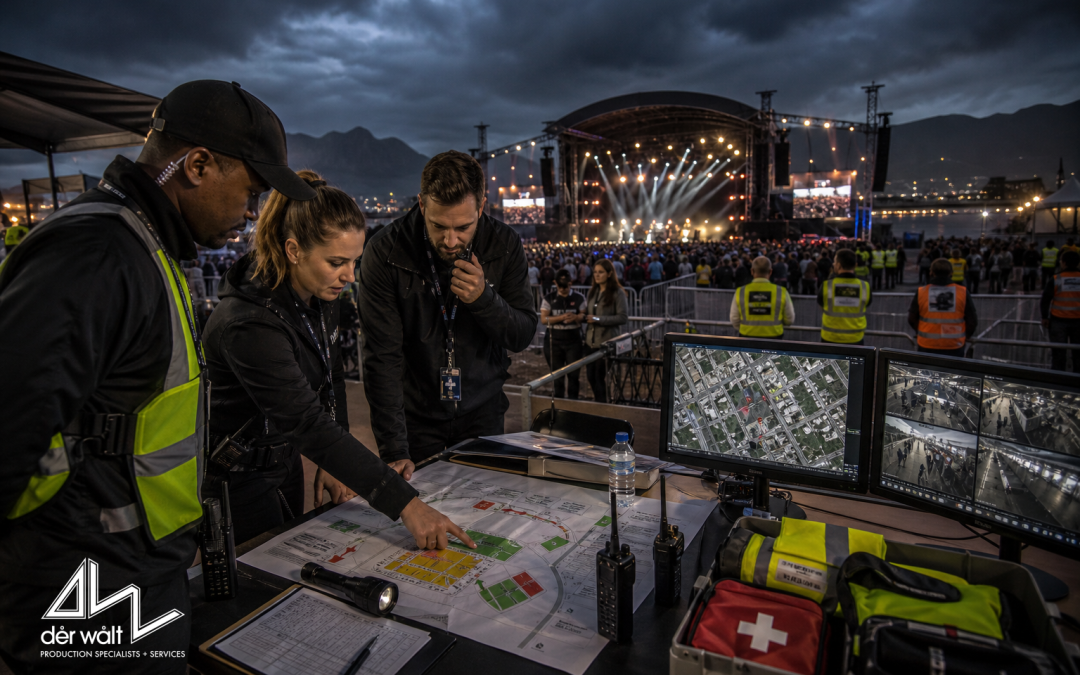
Establish a clear safety governance structure with predefined roles: Safety Officer, On-Site Controller, Medical Lead, Fire Safety Lead, and Security Liaison. Create a control room layout and a single communications protocol for all teams, including a on-site radio or app-based system and an emergency alert process.
3. Build emergency response and evacuation procedures
Develop written procedures for medical emergencies, fire, structural failure, severe weather, and security incidents. Include muster points, route diagrams, evacuation maps, and boss-level escalation steps. Test these through a formal drill and capture learnings for future improvements.
4. Integrate weather contingency planning
South African weather can shift quickly. Build contingencies for heat, sudden rain, or wind. Ensure infrastructure like marquees, rigging, and temporary structures meet safety standards and can withstand local wind thresholds. Predefine trigger actions at specific weather readings (e.g., when to slow operations, halt activities, or evacuate).
5. Plan crowd management and access control
Design ingress and egress routes that accommodate peak crowd flows, including separate entry, exit, and VIP areas. Implement queuing systems, crowd-density monitoring, and real-time decision-making to prevent bottlenecks. Coordinate with venue staff and local authorities on portering, stewarding, and perimeter control.
6. Engage venues and authorities early
Work with the venue’s safety officer, local police or security services, and municipal regulators from the outset. Obtain required permits and ensure your safety plan aligns with venue-specific requirements, local laws, and any SASREA-like expectations around spectator safety and hazardous operations.
7. Verify equipment, installation and supplier safety
Audit all equipment, electrical installations, staging, lighting and sound systems. Ensure lifting, rigging, and temporary structures are installed by qualified crews with proper certifications. Require safety plans from each supplier and verify concurrent proof of insurance and personnel competency.
8. Training, drills and on-site communications
Deliver a safety induction for all staff, contractors, and volunteers. Run a pre-event safety briefing and at least one on-site drill covering the main emergency scenarios. Maintain 24/7 communications during build, event, and strike to keep every team aligned.
9. Documentation, review and continual improvement
Compile a live safety plan that evolves with planning milestones. After the event, conduct a debrief to capture lessons learned and update procedures for future activations. This closes the loop between planning, execution and learning.
Checklist: essential items to implement now
- Signed safety plan with identified roles and contact lists
- Risk assessment matrix with controls and residual risk ratings
- Emergency response procedures, evacuation maps, and muster points
- Weather contingency protocol and infrastructure wind-load verifications
- Crowd management plan including ingress/egress routes and stewarding plan
- Site and supplier safety verification, including permits and insurance
- Staff training, inductions, and on-site drills scheduled
- Control room setup and real-time communication channels
- Post-event debrief process for continuous improvement
Common mistakes and important considerations
- Underestimating weather impact or failing to rehearse emergency procedures with all teams.
- Writing a plan that looks good on paper but isn’t adaptable to real-time changes (weather, crowd size, or logistics).
- Not validating contractor safety credentials or equipment certifications before build.
- Delaying permit and venue safety coordination until late planning phases.
- Ignoring post-event learnings and not updating processes for future activations.
Sources
- ISO 20121:2012, Sustainable events management — International Organization for Standardization (ISO)
- Mass gatherings health guidelines — World Health Organization (WHO)
- NFPA 101 Life Safety Code — National Fire Protection Association
- ISO 31000: Risk management guidelines — ISO
Final call to action
Ready to design and manage your next experiential activation with safety at the core? DERWALT partners with brands and agencies to deliver high-impact live experiences that are safe, compliant and smoothly produced from concept to close. Contact us to discuss your event strategy, production management, and on-site safety planning.
Recent Comments