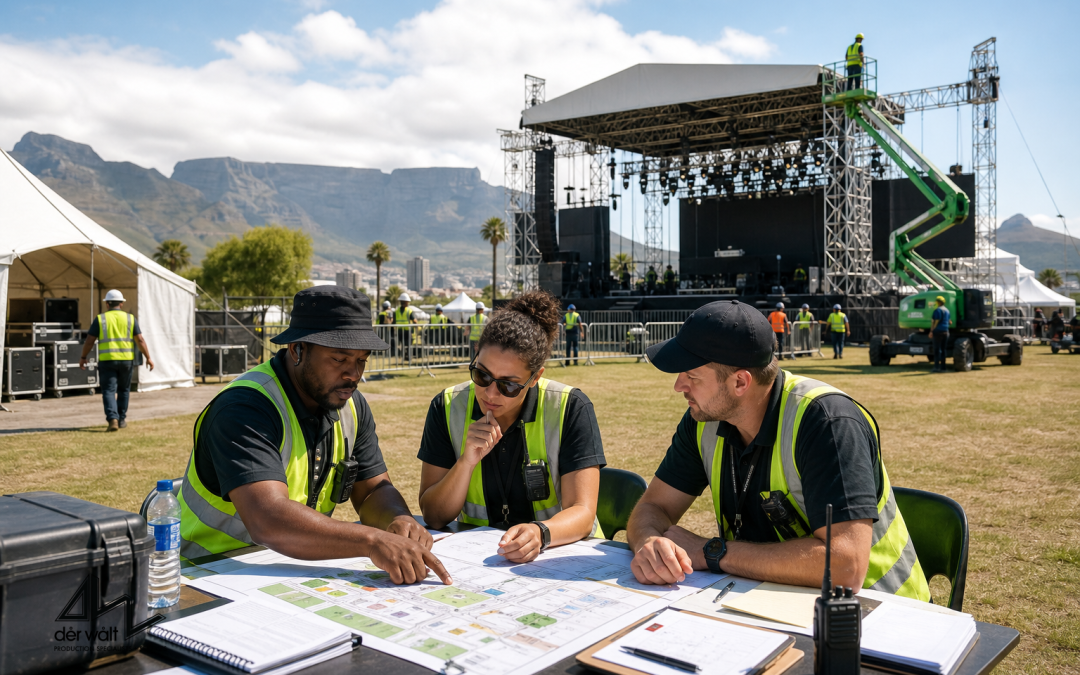
Risk-Based Safety Planning for South African Outdoor Events: A Practical Guide
A practical, field-tested guide for brands, agencies and venues planning large outdoor events in South Africa. Learn how to structure risk-based safety planning, weather contingencies, permits, and supplier coordination for safer, smoother productions.
A risk-based safety plan for South African outdoor events starts with a site-specific risk assessment, then layered controls, and formal approvals to keep people safe and compliant.
What is a risk-based safety plan and why it matters in South Africa
A risk-based safety plan focuses on identifying hazards, evaluating the likelihood and consequence of harm, and applying controls that reduce risk to as low as reasonably practicable. In South Africa, this approach aligns with the Occupational Health and Safety Act and provincial requirements, while addressing climate, infrastructure, and transport realities unique to the region. A well-structured plan helps prevent incidents, speeds up approvals, and protects people, assets, and reputations.
Core components of the plan
- Site-specific risk assessment: a structured process to identify hazards at the venue, stage, back-of-house, and transport routes.
- Management and leadership: clear safety roles, responsibilities, and governance, including a safety officer on-site during setup, production, and breakdown.
- Risk controls: a hierarchy of controls (elimination, substitution, engineering controls, administrative measures, and PPE) tailored to the event.
- Weather and environmental planning: contingency strategies for heat, rain, wind, and lightning, including shelter, hydration, cooling, and wind-sensitive operations.
- Permits and regulatory compliance: adherence to local OHS laws, venue-specific restrictions, noise controls, and crowd safety requirements.
- Vendor and supply chain coordination: prequalification, safety briefings, and on-site compliance checks for all contractors and suppliers.
- Emergency procedures and communications: clear incident reporting, muster points, evacuation routes, and multilingual communications where needed.
- Training and drills: targeted training for staff, volunteers, and contractors with pre-event, event-day, and post-event reviews.
- Documentation and audit trail: risk assessments, checklists, permit records, and incident logs for accountability and continuous improvement.
Practical steps to build the plan
- Define scope, objectives and success metrics for safety and operations.
- Assemble a safety team with clearly defined roles (Safety Officer, Security Lead, Medical Lead, etc.).
- Conduct a site walk-through and a hazard identification session (HAZID) to surface potential issues before staging begins.
- Perform a formal risk assessment using a likelihood-versus-consequence matrix; document top risks and assign owners.
- Choose and document risk controls using the hierarchy of controls, prioritising engineering and process changes before relying on PPE or compliance alone.
- Develop weather contingency plans tailored to the venue climate; plan for heat stress, rain, wind, and lightning, with specific triggers and actions.
- Secure permits and ensure all relevant regulations are met; confirm venue permissions, transport restrictions, noise limits, and crowd-control requirements.
- Coordinate with suppliers and contractors early; provide pre-event safety briefings, access controls, and on-site safety checklists.
- Establish emergency procedures, communication channels, muster points, and evacuation routes; rehearse with staff and security teams.
- Create a live safety dashboard for on-site monitoring, including weather changes, risk flags, and incident reporting.
- Document everything and build into a post-event debrief for continuous improvement.
Weather contingency and SA-specific considerations
Outdoor SA events face a range of weather scenarios—from summer heat to sudden storms and high winds. Build contingencies that reflect local climate patterns and venue capabilities. Practical measures include: shaded rest zones and hydration stations for heat, covered or retractable spaces for rain, secure staging and rigging for wind, and lightning-safe procedures aligned with local guidance. Regular weather monitoring from official sources should be integrated into the production schedule, with clearly defined triggers for delaying, relocating, or cancelling activities.
Supplier coordination, procurement and permits
Effective supplier coordination reduces risk and keeps timelines intact. Actions to implement:
- Pre-qualification of all contractors with safety records, insurance, and equipment checks.
- Joint safety briefings before site access and on-boarding for all subcontractors.
- On-site safety monitoring and a single point of contact for safety concerns.
- Detailed permit planning: confirm necessary approvals (venue, municipal, traffic, noise) with lead times and renewal processes.
- Clear agreements about site lines, load-in/load-out schedules, and restricted access zones to protect vendors, staff and attendees.
Documentation and budget alignment
A robust safety plan is underpinned by documentation and budget integration. Keep risk registers, job safety analyses, and incident logs up-to-date. Build safety costs into the overall event budget, including contingencies for weather-related delays, additional staffing, medical services, and emergency equipment. Align procurement timelines with permit approvals to avoid last-minute changes that could compromise safety or compliance.
Checklist: quick-start safety plan template
- Site walk-through completed and hazards logged
- Risk assessment with owner and time-bound actions
- Weather contingency plan with triggers
- Emergency procedures and muster points documented
- All permits identified, applied for, and secured
- Pre-event safety briefings conducted for all teams
Common mistakes and considerations
- Underestimating weather-related risks or failing to update plans after venue changes.
- Relying on PPE alone instead of layering controls (engineering, administration, and procedures).
- Inadequate on-site training for contractors and volunteers, leading to inconsistent safety practices.
- Incomplete permit and regulatory checks, risking delays or shutdowns.
- Poor communication channels during live events, which can hinder emergency response.
FAQ
What is a risk assessment for events?
A risk assessment identifies hazards, evaluates the likelihood and severity of harm, and defines controls to reduce risk to an acceptable level.
What weather considerations are essential for outdoor SA events?
Plan for heat, rain, wind, and lightning with triggers, shelter, hydration, and evacuation procedures aligned to venue capabilities and local guidance.
Which regulations apply to mass gatherings in South Africa?
Event safety must align with the Occupational Health and Safety Act and venue-specific permits, including municipal and traffic regulations where applicable.
How do you communicate safety plans to staff and contractors?
Use pre-event briefs, on-site briefings, printed checklists, and a live safety dashboard to ensure everyone understands roles and procedures.
How can brands minimise costs without compromising safety?
Invest in engineering and administrative controls early, standardize safety processes across suppliers, and use scalable contingency strategies rather than ad-hoc fixes.
Sources
- ILEA: International Live Events Association — International Live Events Association
- Event Safety Alliance — Event Safety Alliance
- IAVM: International Association of Venue Managers — IAVM
- South Africa Weather Service — WeatherSA
- Mass Gatherings Guidance — World Health Organization
Contact DERWALT for experiential marketing, activation or event-production support
Ready to translate safety-first planning into memorable, data-driven live experiences? DERWALT provides end-to-end event strategy, production management, and logistics coordination for experiential activations. Reach out to discuss your next outdoor activation and how we can help navigate safety, permits, and supplier coordination while delivering standout audience experiences.
Recent Comments