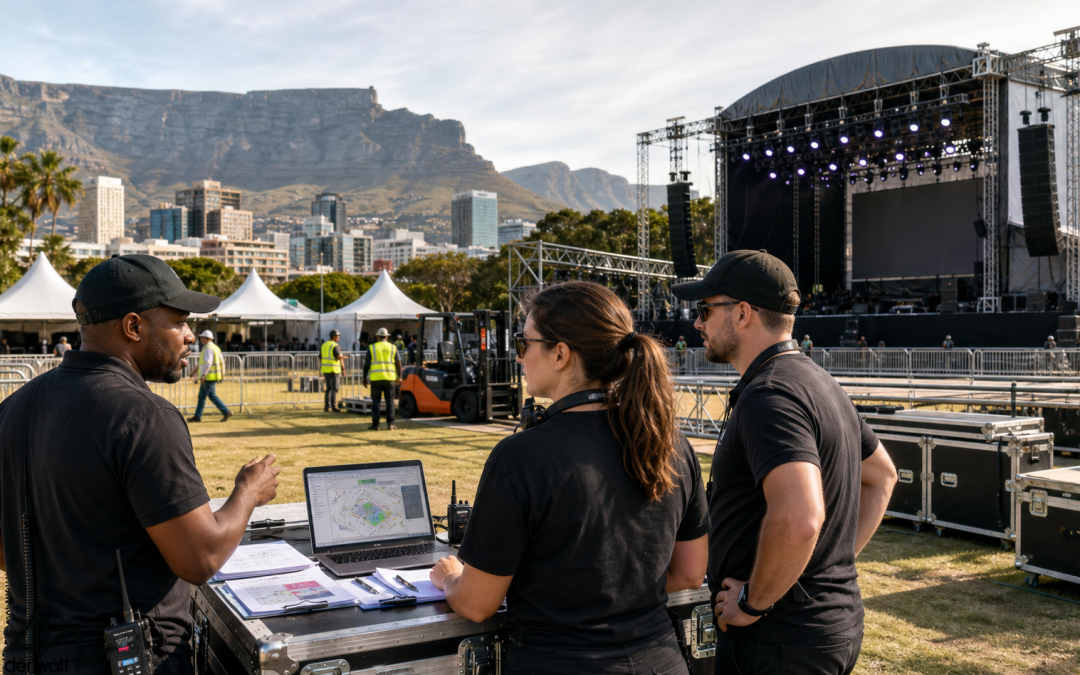
Practical guide to safe, compliant live events in South Africa
This guide outlines a pragmatic approach for brands, agencies, and venues planning live events in South Africa. It covers permits, safety planning, weather contingency, procurement, transport, and budgeting to help reduce risk and keep timelines.
South African live events demand a pragmatic approach to planning across multiple moving parts. From permits and safety planning to weather contingency, transport logistics, and procurement, the success of an activation rests on strong pre-production and disciplined on-site execution. This article offers practical, SA-context guidance for brands, agencies, venues, and production teams aiming to deliver compliant, safe, and engaging experiences without overrunning budgets or timelines. It also outlines how a structured production framework — aligned with recognised safety and management standards — can help teams collaborate more efficiently, with fewer last‑minute surprises.
Understanding the regulatory landscape for South African events
In South Africa, there is no single universal permit for all events. Organisers must align with national health and safety expectations and with local by-laws, which are typically administered by the venue’s or municipality’s offices. Key considerations include occupational health and safety requirements, noise controls, waste management, traffic and crowd management, and, where applicable, liquor licensing. The exact permits and approvals required depend on the venue, city, and the event’s scope. Always verify requirements early with the relevant local authority to prevent delays that could cascade into venue and talent scheduling conflicts.
Permits and compliance
A practical approach is to map the jurisdictional landscape for your venue early in the brief. Engage the municipality as soon as the site is identified and request a checklist of required documents. Common elements include a site plan showing ingress/egress, a safety and security plan, a traffic management plan (TMP), a waste management plan, and proof of public liability insurance. If the event involves road closures or major disruption to existing traffic flows, you may need a dedicated road closure permit and coordination with local traffic authorities. Factor lead times into your schedule; in larger urban centres, approvals can take several weeks. Always incorporate a contingency buffer for unexpected regulatory requests and ensure that all suppliers and contractors carry appropriate insurance and certificates of compliance.
Labour, procurement, and local sourcing
South Africa’s procurement and labour landscape emphasises fair labour practices and, where relevant, supplier diversity and localisation. Build your procurement plan with clear supplier criteria, including safety records, compliance, tax clearance, and BBBEE considerations where applicable. Engage with labour representatives or unions where relevant to minimise on-site labour disputes and to align on a safe, predictable working environment for crews. Where possible, prioritise local suppliers and crew to support community capacity, while ensuring that all contractors have the required qualifications and site inductions. Transparent SLAs and defined escalation paths help prevent budget creep and keep timelines intact.
Safety planning and risk management
A robust safety framework is not optional in today’s live event world. Treat safety as a design parameter that begins at concept and runs through to post-event wrap. A formal structure such as an occupational health and safety management system helps teams anticipate risks, coordinate responsibilities, and respond effectively when incidents occur. While formal certification (like ISO-based systems) is not mandatory for every event, using a structured approach provides a repeatable baseline for risk assessment, emergency planning, and on-site coordination.
Creating a risk register and HASP
Develop a risk register at project outset, identifying hazards across people, place, process, and equipment. For each risk, document likelihood, potential impact, precautionary controls, and escalation paths. A comprehensive Health and Safety Plan (HASP) should include contact lists, emergency procedures, medical support arrangements, first aid readiness, fire safety, electrical safety, and crowd and access control. Assign a designated Safety Officer or a small safety team with clear roles for supervision of subcontractors, hazard reporting, and on-site briefings. On large productions, conduct a pre-event safety walk, stage checks, and a post‑event debrief to capture learnings.
Weather and environmental planning in SA
Weather in South Africa varies by region and season, with coastal zones often experiencing humid afternoons and sudden storms, while inland areas can face sharp temperature swings. Weather can impact everything from power needs to audience comfort and equipment protection. Build weather resilience into every plan: shade and misting for hot conditions, rain covers and drainage for storms, wind considerations for rigging, and contingency timing for outdoor performances. Rely on trusted forecasts from the South African Weather Service (SAWS) for day-of planning, and maintain a live weather monitoring protocol as event day approaches. Have backup power strategies for heat waves or load-shedding, and ensure outdoor gear, trussing, and scaffolding are rated for anticipated wind ranges in your venue’s locale.
Logistics and transport: moving crews and gear smoothly
Transport, access, and cargo handling are often the most time-sensitive and cost-driving parts of a production. Urban venues require clear delivery windows, road access planning, and secure loading zones that do not disrupt surrounding traffic. For rural or multi-venue activations, plan for equipment relocations between sites, including transport routes, vehicle hire, and crew shifts. Consider the following practical steps: coordinate with venue operations teams on loading docks and parking; establish a clear access control plan to manage audience flow and personnel movement; arrange reliable power distribution and on-site generators with appropriate sound mitigation; implement a basic security plan for gear and stage areas; and schedule rehearsals and load-in times to minimize daylight exposure and weather risk. Inclusive transport planning also means factoring in accessibility for staff and attendees and ensuring emergency vehicle routes are unobstructed at all times.
Budgeting, procurement, and vendor coordination
Budget discipline begins with transparent cost estimation and clear scope definitions. Build a contingency buffer for weather, permits, and supplier lead times, and actively manage currency and import fluctuations if equipment or services come from outside South Africa. A structured procurement process helps control risk: issue clear briefs, conduct objective supplier evaluations, and lock in SLAs with performance-based terms. Consolidate purchases to reduce freight and handling overhead, and align on delivery windows to avoid last-minute rushes. For large productions, a dedicated procurement lead can coordinate with local vendors and ensure compliance with safety and insurance requirements. Practical vendor coordination includes regular pre-event meetings, shared run-orders, and on-site point(s) of contact to accelerate decision-making and maintain schedule integrity.
Production timeline and practical checklists
Every event benefits from a realistic, phased timeline that starts well before show day. In South Africa, the planning window may range from several weeks for small activations to several months for complex multi-venue productions. A practical phased approach can look like this: discovery and brief development; site assessment and regulatory scoping; design and creative finalisation; risk assessment, HASP development, and permits; supplier sourcing and contracting; design finalisation, content creation, and rehearsals; venue and staging logistics, access and crowd control planning; technical run-throughs and safety checks; on-site rehearsals and final checks; show day operations; and post-event wrap and debrief. Build milestones into a shared project calendar and maintain frequent communications with all stakeholders (clients, venues, suppliers, and internal teams). Documentation and change-control discipline help prevent delays from scope creep or missed approvals.
DERWALT brings end-to-end capabilities to support this cycle — from event strategy and production management to stage and show production, logistics, supplier coordination, content creation, and on-site delivery. By applying a structured, safety-focused approach to planning and by maintaining strong relationships with local suppliers and venues, teams can reduce risk and improve predictability across South Africa’s diverse event environments.
Sources
- Occupational Health and Safety Act — Department of Employment and Labour — Department of Employment and Labour
- South African Weather Service — South African Weather Service
- ISO 45001: Occupational Health and Safety Management Systems — International Organization for Standardization
Contact DERWALT for experiential marketing, activation or event-production support
Ready to plan your next activation with experienced production partners? DERWALT offers end-to-end experiential marketing and event production support across South Africa, from strategy and procurement to on-site management and content delivery. Get in touch to discuss your needs.
Recent Comments